A Balanced Approach to Wellness!

Post 114-aiplane window

Anxiety comes from one main source: emotional emptiness. Anxiety fills in the empty spaces when the emotions are out of balance because of uncertainty about the future or because of hormonal and sleep irregularities. One cause is physiological and one is not.

In general, when the cause of anxiety is physiological (hormonal or sleep related), a response will be “flight”: flight from the problem, flight from a relationship, denial of the anxiety, or denial of responsibilities. Flight can be actual leaving (a relationship, work, or community) or distancing emotionally.

The physiologically induced anxiety is relieved through focus on the causes: changing negative sleep patterns, curtailing unnecessary activities, reevaluating shift work situations, examining a lack of human contact, elevating the importance of sleep, reorganizing reality, and prioritizing nutritional deficiencies.

In general, when the cause of anxiety is uncertainty about the future, the response will be “fight”: resistance to offers of help, resistance to inner knowledge of solutions, fighting through instigation of arguments, fighting with oneself through self-harm, fighting with others through physical blows, struggling for dominance, quarrelsomeness, or protection of position. The “fight” response can be appropriate in cases in which aggression has been understood to be the only response, but not when aggression is chosen by default.

The anxiety from uncertainty about the future is relieved by awareness of uncertainty for everyone, by belief in the ability to function without knowing the future, by accepting the cycles of life, by prioritizing nutritional balance, and by focusing on supportive relationships.

Anxiety has fight or flight responses. Other negative states have different responses. See the blog post What’s up with “fight or flight”?.

Note: This information has been spiritually received.


Distracting colors

Are “fight or flight” our main responses to fear and stress? That’s what everyone says, but is that so? I’ve asked Spirit, because I want to know. Here’s what Spirit informs me:

People have built-in mechanisms that evaluate danger. (We can call them signals and pulls.) These mechanisms help us evaluate situations and feel how to respond. Our responses depend on many things: age, health status, physical impediments, mental breadth, hunger or thirst, breath capacity, emotional attachments, emotional memories, abdominal state, vision, fears, and awakeness. Besides these uniquely personal statuses, we are influenced by our family, neighbors, responsibilities, and desires.

When a situation requires a response, our bodies (intangible and tangible) must process a response that suits our personal statuses and our outer circle. If the outer circle (family, neighbors, etc.) has strong influence, then our response will be geared towards others. If our response is completely our own, then the personal statuses will force us to devise a response to suit our current situation. If we choose a response that doesn’t suit (for example, choosing to hide when we are too exhausted to move), our signals or pulls will usually join to give us the ability to pursue the chosen response.

Here are typical responses to fear and stress: hiding, lowering to the ground, pulling inwards to be physically compact, freezing in place, falling asleep, entering a shock state, denial, emotional displays (crying, sobbing, begging, anger), and confusion. And possibly, fight. And possibly, flight.  Fight and flight are two responses among many so that to speak only of fight or flight is an incorrect characterization of human response.

Each of the responses has a different effect on the body, some effects being more destructive than others. Stress that is handled through freezing in place or denial has differing effects than fight or angry actions. Stress that is denied can be more destructive than stress that is released through tears. Fear that is handled by hiding can be permanently installed in the body, while fear that is handled through entering a shock state can be forgotten. Each response yields a different effect on the body depending on the personal statuses and the forces of the outer circle.

Characterizing the effects of fear and stress as fight or flight is too broad. Each person is an individual response being, and no two people are alike.

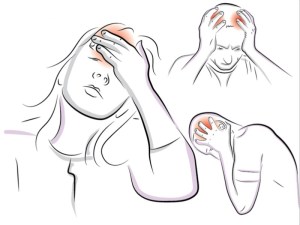
Migraines are signs that bodily communications have been ignored, and the body is yelling for attention! The attention needed for migraines differs from the attention needed for headaches, but both are cries for relief. Relief from the medicine cabinet is usually the relief the body doesn’t like, and this “solution” is best saved for last place.

The body can suffer in many ways; however, migraines differ from other types of physical pain because they take the sufferer into a special realm of being: into “Migraineland”.

Migraineland

It’s a place that is entered suddenly or in stages, and once entered, it commands attention. Migraineland is experienced by all ages, and it is a way of living that is sometimes passed from generation to generation.

The causes that unleash the reality of Migraineland living are many, and each person lives the reality with individualized distress. Sensitivities to foods or cleansers or sounds can delineate a direction into migraine territory, so that their influence actually initiates a migraine or encourages other migraine activators to initiate migraine domination of the body.

Other migraine activators are: sleep deficiency, seasonal fluctuations, uninterrupted viewing of screens for too long, medications that produce migraine reactions, ignoring the urge to defecate, constipation, contact with poisonous substances, light (natural and artificial), daily encounters with crowded living, abrupt changes in altitude (for example, when climbing a mountain) or speed (for example, when riding a roller coaster), erratic eating, compression of spinal nerve roots in the spinal cord, inactivity of the ileocecal valve in the small intestine, and certain metals. These activators can initiate a migraine or encourage other activators to initiate migraine domination of the body.

A person’s emotional state can also initiate a migraine or encourage other migraine activators to initiate migraine domination of the body. Emotional activators are worry, sorrow, constant suspicious view of others, feeling that overwhelming sense of guilt, self-induced or externally applied pressure, and weariness and sadness from societal tragedies and events that are not directly felt but cause personal anguish.

These emotional activators initiate different types of migraines. Their appearance varies throughout a person’s life, and they prompt migraines when they have emotional control of a person’s thinking. Emotional activators are not easy to see as causes of migraines, but they are very involved in creating Migraineland.

Sometimes a child learns migraine suffering from a parent. Migraines are not genetic, but they live within mimicable behavior and adapt to lifestyle differences. The experience of a migraine is a bonding rite of passage for a parent who unwittingly teaches the child to suffer. Intergenerational suffering in Migrainelands’ clasping grasp and possessiveness belies the differences that create each person’s set of migraine initiators.

To understand migraines demands understanding consequences. Migraines build upon dysfunction in the body. Dysfunction differs in each body so that the migraines differ in presentation, which confuses healing steps.

To heal migraines requires understanding the consequences of choices, limitations, and outlook. Each person suffering with migraines creates a personal Migraineland. To prevent migraines, Migraineland must be squeezed down and not be entered. Closing down Migraineland heals the migraine way of life. Many of the causes are listed above, and dealing with them can lead to the closing down of Migraineland.

Migraines become a way of life, a way that is off the true path of living. The efforts required to let them go are sometimes confusing, but they bring relief and healing.

Note: Spiritual Presence shares this information so that the path to healing can be understood.


Spiritual connection

Someone to Watch Over Me

Perhaps there are angels that
watch over me.
Perhaps there are twinkly-beings that
light my way.
Perhaps there are helpers that
guide my daily strivings and focus my efforts.

There are, there are, there are.

Someone to watch over me
when despair strikes
when sadness wearies
when the way is unclear
when joy is felt and calling to be shared
when excitement is felt and calling to be shown.

Someone to light my way
when the path is blurred
and the signs are missing.

Someone to guide my daily strivings
so I find my stride
and perform my best
and achieve my goals.

Someone to focus my efforts
so I see the steps
and move with ease
and grow in wisdom.

Perhaps there are angels that watch over me
and twinkly-beings
and helpers too.

Yes! There are!

There are, there are, there are.

This poem is from Unfolding—A Collection of Wisdom Poetry, which is available on amazon.com: http://amzn.com/1508828229

Unfolding book cover

ocean and boat

I’m at the age where my friends’ parents are dying. My own parents are long gone, as are most of my aunts and uncles, and a few older cousins. Conversations with neighbors often focus on retirement ideas, aging, and occasionally, on death.

Death is always at the door, but it has seemed to be a distant thing, or a fluke of a younger person dying. Tragedies have been all around, but not personally felt. Actually that’s not completely true. A dear colleague died many years ago, and so too, a close acquaintance. Those deaths were over twenty years ago, and I have learned to live without those people in my life.

Spirit is pushing me to write about death, and I ask, why? I’ve written about death before in several books. What is there new to say?

Here’s what Spirit tells me: The people who write about the connection of the dead with the living are writing truth. There are strong connections that can be felt. An openness is needed to feel the messaging, and a willingness to stay still and hear is required. The dead have apologies to impart, explanations to make, and guidance to give. The line between alive and not alive is thinner than we think. Crossing over is a natural thing.

For my friend whose father is edging towards the crossing over: hold his hand and listen for his silence. The silence will end when the crossing over takes place, and then, if you stay still and hear, the messaging may start.

Food 20-20

The Food 20/20 Plan

Now is the time to focus on eating properly to stay healthy, disease free, and youthful. Here is the way to eat to keep yourself balanced and full of vitality!

Eating well includes the foods we eat and the atmosphere we create when eating. Each of these aspects is important for our bodies’ well-being.

Let’s look at the Food 20/20 plan to understand it.

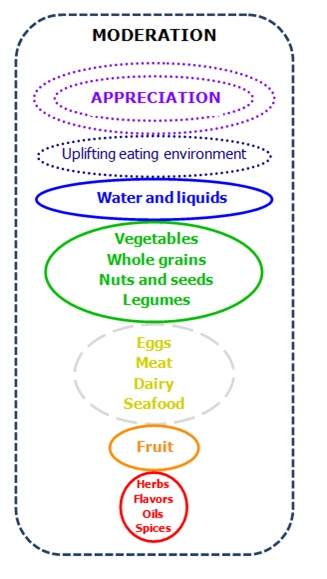
Moderation. Moderation comes above all parts of Food 20/20, because moderation is needed in consumption and in intention. Foods eaten in moderate amounts nourish properly.

Appreciation (violet). Appreciation, without excessive fixation on being appreciative, helps food be spiritually nourishing.

Uplifting eating environment (indigo). The atmosphere in which food is eaten influences physical, emotional, and spiritual growth. When food is consumed in the company of others, at a relaxed pace, and without stress, the food is received by the body optimally.

The Blue group: Water and liquids. Water is the basic external requirement that we need in order to live. It is the food group that cannot be skipped. Nourishing liquids, besides water, that provide vitality are good. Liquids that contain substances such as caffeine, sweeteners (natural or synthetic), and colorings, are wizening.

The Green group: Vegetables-Whole grains-Nuts and seeds-Legumes. These foods form the basis of substances that are satisfying and balancing.

The Yellow group: Eggs-Meat-Dairy-Seafood. These foods require additional appreciation towards the lives that produce them. When eaten, they supply nourishment and satisfaction; however, they are less balancing than the Green group. The Yellow group appears with a dashed, gray line, because of ethical and sustainability concerns.

The Orange group: Fruit. Sweetness is best eaten slowly and savoringly. Fruit contains nutritious elements and unbalancing aspects. The sweetness can be unbalancing and requires balance from the Green group.

The Red group: Herbs-Flavors-Oils-Spices. These foods are best eaten in small amounts. They add tastiness and tweaked accessibility to the main groups of foods. Flavors include sweeteners such as date syrup, maple syrup, stevia, and honey. This group is meant to enhance food and not detract from food’s nutritious role. This group does not include eye-catching additives that harm health.

Food 20/20 presents the importance of non-food aspects of eating. These aspects are enclosed by dotted lines to indicate their intangibility. Appreciation is emphasized with a double oval, because of its effects on health.

The food groups decrease in size to indicate the amounts to be eaten. The foods in the Green group: Vegetables-Whole grains-Nuts and seeds-Legumes are meant to be eaten as the main elements of a healthful diet. The other groups are meant to be eaten in smaller and smaller amounts.

Following the Food 20/20 plan opens our bodies to elevated health and fulfilling dining experiences!

Note: Food 20/20 was given to me by Spirit!

annoying family

Yelling is a design feature in humans. It is a way to attract attention and change focus. Yelling can prevent disasters when it is produced from a natural desire to protect. Yelling can weaken relationships when it is produced from a natural feeling of uncertainty.

When yelling takes place, the person yelling has elevated blood pressure and suppressed immune system, no matter the reason for the yelling. The yeller is in a position of vulnerability, because of the physiological changes. When the yelling is accompanied by lack of sleep or dehydration, the yelled messages are less controlled. Lack of sleep affects yelling volume; dehydration influences the words that are yelled.

When yelling takes place, other systems in the body slow down. If the yeller is a pregnant woman, the fetus is protected but the other systems are slowed even more. If the yeller is angry, the systems are slowed to the same extent as the pregnant woman.

Yelling is a natural expression of impatience released, and it forces its way out when not controlled. Yelling naturally expresses frustration, discomfort, and desire to be heard.

Young children yell when their caregivers ignore them or refuse to give them what they want. They naturally express their state-of-being, unless they have been socialized to withdraw.

In relationships, yelling is an expression of human desire to be heard, to be agreed with, to be supported, and to be wanted. The yelling can rage out of control if lack of sleep, hunger, intense sadness, or hormonal imbalance are present. Yelling can be beyond control, sometimes because of physiological causes and sometimes because of developmental limitations.

Cultures that discourage yelling rely on skills of listening thoroughly to one another and on development of clear expression. Cultures that glamorize yelling often have an emphasis on spontaneity, which can lead to uncertainty in a person’s standing with others. Cultures that inhibit personal expression often produce highly volatile members. They may not yell, but they may explode through destructive actions.

When the feeling to yell occurs, depending on one’s culture, the feeling can be examined or actualized. Yelling is a natural release, but it only brings satisfaction if the listener is prompted to act judiciously. When yelling occurs, it is an opportunity to examine communications and feelings. If the feelings have sad or uncertain undertones, the yelling is simply a symptom and an opportunity for better energy (atmosphere, physical state [balance, hunger, sleep], communication, education).

Our design is exact, and the ability to yell in order to be heard is part of that exact design.

Note: This information has been spiritually received.


Why do people

Some of the things we do are individualistic and some are caused by our similar design. For example, people yell at one another because of a design feature!

When we create, we express individual personality, ideas, and experiences. When we interact, we pull on instinct, hormonal influences, and gut reactions. The interaction forces are grounded in the design features that make us similar to one another.

By understanding our design, we can know how to deal with others properly. The next few blog posts will be about the reasons we people do some of the things we do.

Note: Spirit is sharing the design information so that interactions can be more understanding.

No Sleep

“Sleep is essential. Sleep is the second-most important need of the body, after water and before food. Sleep must be scheduled and must be regular. Each person’s need of continuous nighttime sleep fluctuates with age, occupation, and location. Each person should understand his or her sleep requirements and be mindful to fulfill them.”

– from “Behavior & Release” in Pond a Connected Existence

“During sleep, the body recharges, repairs, restores, and rethinks. Sleep can make or break us, depending on its quality. Here are general tips for better sleep:

  • Sleeping posture is very important. The spine needs to stretch out so don’t curl up into a ball.
  • Going to sleep hungry or going to sleep too full contribute to less satisfactory sleep. Make sure that you are sufficiently un-hungry before you get into bed. If you are too full, put off sleep for an extra 45 minutes.
  • Going to sleep before handling feelings that are negative (anger, hurt, or annoyance) can lead to unsettled sleep. If you cannot let go of the negative feelings before going to sleep, be sure to stretch your body when you get into bed and point-and-flex your toes for a few moments. Loosening your body in bed can help you release negativity before sleep.
  • The well-known tactic of writing a To-Do list for tomorrow is a wise move. Be sure to write the list at least an hour before bedtime so your mind does not continue to think about your upcoming tasks.
  • The less light in the room, the better. If you can sleep in complete darkness, then your body will be able to handle its restorative work more completely. This tip also applies to children. Night lights are for the parents more than they are for the children.
  • If you wake up in the night, don’t assume you won’t be able to go back to sleep. Assume that you will, and you usually will.
  • If you wake up tired, try going to bed earlier, lessening stimulants (if you use them), and getting more physical exercise.

These tips are generalizations because each person’s sleep issues are personal. Sleep trouble is influenced by lack of balance including incorrect nutrition, lack of exercise, going to sleep troubled, going to sleep scared, using stimulants, noise, convoluted days (working at night and sleeping during the day), too much stimulation close to bedtime, sleep posture, and temperature in the bed. If you can address these issues, then your sleep should improve.”

– from “Vitality! Sleep Requirements” in Vitality!— How to Create a Life That Is Healthy

imitating glasses

Like double-strand yarn or the double helix of DNA, happiness and joy wind and twist around each other. The reaction that gives joy also gives happiness, and the sense of happiness brings.joy.
They aren’t the same, but they are simultaneous.
The question, “Are you feeling Joy or are you feeling happiness?”, is difficult to answer, because the two are so connected. A joyous moment provides happy memories, and a happy event sends in joyous sensations. One without the other is rare.

caringHappiness & joy–twinned reactions are part of our design! 🙂

Note: Spirit shares this information to give us insight into our design.

failure at math

Several readers wrote to tell me that the blog posts “Failure addiction is taught” and “Addiction to failure” explained family members’ difficulties in life. Until they read those posts, they had not been able to understand the inability of their siblings/children to function.

The distressing state of drug addiction (legal and not) to combat anxiety, sleeplessness, and normal coping behaviors, is a reason to look more deeply at failure addiction and its causes. The lack of success in relationships and in achieving goals are additional reasons for looking at the causes of failure addiction.

As stated in “Failure addiction is taught”, children experience uncertainty and dejection when their parents–or other beloved caregivers–are emotionally distant, are consistently absent, and ignore their children’s natural interests. Children are sensitive to the words and actions of their loved ones, so that distancing and disinterest harm their sense of self, which in turn, causes them to doubt their abilities and thwarts their capacity for perseverance. Without perseverance and belief in oneself, a person cannot achieve goals.

Attentive parents can instill tendencies towards failure addiction when they require achievements that don’t suit their child’s abilities and interests, when they push away natural childhood demand for affection (from the parent), and when they purposely ignore their child’s expressions of himself or herself (for example, seeing that the child has a sensitive nature and pretending that the child is unflappable).

These “attentive” parents create people who may “succeed”, but feel unable to cope. Eventually, the inability to cope will affect work, self-perception, and/or appetite. The failure-prone people will struggle throughout their lives with relationships, unless they are able to adjust their self-images.

Failure addiction causes breakdowns, breakups, and breakaways. It is a cause of depression, compulsive behaviors, eating issues, and social withdrawal. Failure addiction indicates deep sadness, and deep sadness is the source of debilitating anger and aggression.

Failure addiction is a heart impediment. It stops the intangible heart from opening to oneself and to others, so that the intangible heart is stunted and enfeebled.

Note: This information has been received from Spirit.

Flu Prevention

no-to-fluWe can lessen the possibility of being sickened from flu viruses if we do at least five of the following things:

  • Sleep the proper amount for your body. The body requires enough sleep to fortify against invading germs. A weary body struggles against powerful flu viruses.
  • Breathe protectively. Shallow breathing cannot supply oxygen like deep breathing. The more rhythmic and deep the breathing throughout the day, the more the body can withstand flu vitality.
  • Create music or listen deeply to music during the winter season. Music has a protective effect on our bodies.
  • Wear clothing that protects. Don’t wear clothes for warm weather in the winter. Don’t overdress in overheated spaces. Don’t over-shiver (shivering is a normal reaction to cold, but over-shivering means the shivering has gone on for too long or the intensity of the cold is too much for your body).
  • Food: eat cruciferous vegetables (broccoli, radish, cabbage, cauliflower, arugula, etc.), parsley, lemon, orange-colored vegetables (carrot, sweet potatoes, pumpkin, etc.), pomegranate, mulberries, buckwheat, garlic, blackstrap molasses, kombu seaweed. Eat a reasonable amount of food each day. Too much food taxes the body’s defenses. Too little food lowers the body’s resistance.
  • Stay hydrated throughout the day. The body can flush out flu viruses when fluids are flowing optimally. Water is the best hydrator, followed by barley tea and parsley juice/tea.
  • Stay active. Keep exercising and moving throughout the winter months.
  • Stay away from people carrying a flu virus. The easiest way to spot a carrier is to notice their vitality. People carrying a flu virus that is transferable have given their vitality to the virus. (By the time carriers have the flu symptoms, they may have already passed the virus on to others, so looking for lack of vitality is an early clue to virus protection.)
  • Stay optimistic, which offers protection from many types of germs.
  • Aim to feel content, which also offers protection from many types of germs.


Note: This information has been spiritually received.

ten commandments

Oxygen gives us life that fits our bodies and our mental well-being. So too, the Ten Commandments! They are a source of many minor reactions and many major changes–both oxygen and the commandments. In their own ways they bring order, connection, and creation.

The Ten Commandments have pertinence today, although their focus has been seen by some to be irrelevant. Their messages are straightforward and yet, they have been held at bay by people who choose to enable contrary actions.

Here is a commandment to consider when facing your daily dilemmas:
  • Give your time to sensitivity: Sensitivity towards family, neighbors, and outsiders. Sensitivity to the needs of the animals that feed you. Sensitivity to the Earth’s treasures. Sensitivity to the ebbs and flows of all life.

Spirit shares this commandment, because sensitivity is missing in too many interactions and decisions. Sensitivity brings positive results and less illness.

transgender

Throughout history, men and woman have struggled with sexual orientation. Some have been able to live a life that suited their perceptions of themselves, because they lived in societies that were either accepting or they lived outside the confines of their society. Those who struggled to live within their society’s sexual boundaries often suffered from emotional and internal questioning and policing.

Sexual orientation is a DNA-related determination. DNA generally assigns sexual orientation in a standard process: female physicality with female perception, male physicality with male perception. The process can be disrupted or stunted so that the standard male-female perception-physicality are altered.  The changes to DNA occur in utero. (This alteration can also happen to various animal groups.)

Sexual orientation is felt through hormonal input. The hormonal push to be male or female is also standard. The hormones and their development can be rearranged because of external triggers so that behaviors of sexual nature become shifted. (This alteration does not happen to other animals.)

Society is accepting or not accepting of the unstandard. Having unstandard DNA assignment is a fact. Living with it is the norm, but if society is unwilling to be accepting of unstandard DNA assignment, the people who receive homosexual or gender oppositing assignment are forced to live falsely. This type of living is difficult and diminishing.

Some societies are open to the reality of DNA assignment that is not standard. This openness enables living according to DNA assignment, and sometimes allows for additional acceptance of hormonal rearrangements. The societies that create space for the people who feel that their hormonal calls are for exploration of unfamiliar orientation (transgender) are societies that move beyond the ordinary.

The use of medical treatments to enhance transgender orientation is not enhancing to the people who receive it. They may think it will be valuable, but it creates restrictions rather than releases.

Note: This information has been spiritually received and is not based on scientific research.


Cover-Contracts for an exemplary life

Health improvements, self-development, changes in behavior, changes in habits, and legacy building are goals that can be reached when Exemplary Life contracts are used. An exemplary life is lived when future generations are kept in mind, when habits reflect caring for oneself and one’s family and community, and when activities are chosen that create satisfaction with one’s life.

Improving health can be by eating more nutritiously, scheduling regular physical activity, and learning to lessen stress. Self-development can be by learning to play a musical instrument, developing hobbies, and meditating. Changes in behavior can be by becoming more appreciative and being kinder to oneself and others. Changes in habits can be by revising daily routines that are not nourishing and preventing procrastination. Legacy building can be by spending more time with younger people and evaluating the legacy you want to leave. These are but a few of the topics that can be addressed with Exemplary Life contracts.

Contracts for an Exemplary Life is spiritually received assistance that understands what people want. People want their lives to be expressions of who they are. They want to be actively engaged in living and they want to face the challenges that life presents in a confident and gratifying way. Unfortunately, as they go along, people lose their focus and mire themselves in distracting and destructive activities and habits.

With true-to-me contracts, a person can return to the natural way of being: expressing who the person really is, engaging actively in life, and facing challenges with confidence and satisfaction.

Contracts for an Exemplary Life—Using Contracts to Achieve Your Goals contains help for people who really want to bring change. Contracts for an Exemplary Life is available on amazon.com: http://amzn.com/1518880746

Deadlines

Post 59-focus

When a deadline is looming, people respond in many, many ways. Each person has a way of coping or approaching or ignoring or using the deadline to achieve/fail. Some people aim for success; some people aim for failure. Yes, both are aims and both are normal reactions depending on each person’s attitude, history, and current bodily balance or imbalance.

This post is being presented to those who aim for success. (I bet you thought it would be the other aim.)

Aiming for success is usually a positive aspiration. Success in one’s endeavors is considered to be the goal that should be reached. Success. What is success? The dictionary says that success means the attainment of wealth, honors, position, etc. In society, wealth, the receipt of awards, CEOs, elected leaders, and celebrity are the coveted (eagerly wished for) ideals.

Let’s look at success in life. What are successful life goals?

  • Maintaining good family relationships—not always easy, but worth making a goal.
  • Maintaining community—very important and worth the investment.
  • Maintaining a healthy outlook about oneself—influences all the other goals and is vital for reaching the goals with health and self-esteem unharmed.
  • Maintaining work requirements—delivering (a performance or a report), showing up when expected, influencing others or work conditions,  performing duties properly and with concern (no matter the type of work), providing the needed skills (relearning or staying current as needed), and focusing when focus is required.
  • Maintaining a relationship with the environment and the creatures that inhabit the planet. “Creatures” include animals and people.

Success is large and small. Large and small successes. Public and private successes. Often, the small and private successes are the most important.

Getting back to deadlines—each person determines the approach that works or doesn’t work. Remembering to attend to all of the life goals should help keep focus and lessen wasteful fretting and wasteful actions.

star sunglasses

What happens when we idolize celebrities? Idolizing celebrities removes a person from his or her reality, because the true reality is away from where the “star” is located. The “star” is living a life somewhere else, and the idolizing person lives in a place between reality and fairy tale.

Fairy tale living is half-living that renders the idolizer removed from reality and removed from time.  Idolizing excessively creates facsimiles of the people doing the idolizing and of the people being idolized. Neither facsimile is real.

Obsessively desiring to be like a celebrity prevents a person from seeing his or her own talents. When a celebrity’s achievements spur others to achieve their own goals, the teaching is uplifting. When the celebrity’s achievements become obsessions without causing positive results for the idolizer, the worship becomes destructive.

Celebrities can spread entertainment, innovation and information, but their lives are not worth idolizing. Their lives have corners that others cannot see, and the truth of their existences is often not so shiny.

Here are celebrity obsessive behaviors that cause removal from one’s own life:

  • Displaying a holiday card of the family of a celebrity financial planner as if you know this family is removal from your own life.
  • Following the tweets and instagrams of a celebrity instead of communications from family and friends is removal from your own life.
  • Changing your appearance or buying clothes you can’t afford to look like a celebrity is removal from your own life.
  • Changing your activities to watch a “star” walk by is removal from your own life.
  • Abandoning principles and close people for the chance of spending time with a celebrity is removal from your own life.

Looking beyond oneself for inspiration is normal human behavior. Watching elders teaches customs and traditions. Listening to others with skills or knowledge as a way to improve one’s own skills or knowledge is useful. Studying the achievements of a person who has impacted others in a positive way is enlightening.

Note: Spirit shares this information as a reminder for each of us to develop our own soulfully gifted talents.

failure at math

Addiction to failure is not a natural state. People are born to succeed, but caregivers, society, and natural phenomenon (like natural disasters) can redirect towards failure. Failure can be in one or two areas or can become a defining personality trait.

For example, parents who are emotionally distant to their child, are consistently absent from the child’s life, and ignore the child’s natural interests, can push the child towards feelings of uncertainty about choices and towards dejection. The dejection and uncertainty can then translate into actions that do not suit the child’s natural talents, which can then lead to feelings of failure. This type of failure addiction can affect all areas of a person’s life and can continue into adulthood if the behavior is not questioned and addressed.

Failure addiction that is localized in one or two areas can occur when people are unaware of their natural abilities, their internal pace (that is, the natural speed of a person), their seasonal preferences, and their soulfully felt interests. Localized failure addiction is also influenced by incorrect interpretations of natural floundering when attempting new tasks or by improper responses to a minor mistake that get multiplied into a general opinion of failure.

Failure addiction can be taught by coworkers who constantly criticize and sabotage. It can be taught by teachers who shame and belittle. It can be taught by family members who are demeaning. And it can be taught by a society that rejects and ostracizes members for their behaviors or differences.

Failure addiction is a strain on society, and it is a cause for suicide and illness.

See Addiction to failure

Note: In the spiritual realm, the perpetrators (those who teach failure addiction) are gently guided towards better behavior in future incarnations.


Autumn leavesAutumn has arrived, and brings with it energy to create! This time of year is wonderful for starting projects and achieving goals.
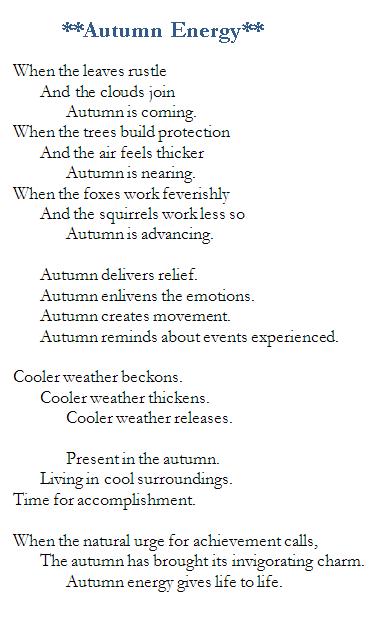
Here’s a poem about Autumn from
Connection—A Collection of Wisdom Poetry.
This book of poetry is available at: http://amzn.com/1511788259

Poem-Autumn Energy

nationalities

Children need love. Lots of it! They don’t need distractions. They need loving attention! They don’t need lots of toys. They need lots of hugs! They don’t need stern warnings. They need kind guidance. They don’t need fighting among family members. They need patience.

Children need loving care. And they need to feel loved.

Note: Spirit says that children are easily damaged. They carry the damage throughout their lives.