A Balanced Approach to Wellness!

Archive for the ‘Focused living’ Category

When we set our alarm clock…

Post 69-People

“Certainty. We all want certainty. And sometimes we get it. When we prepare for things, we often get the desired outcome. When we measure and work in an exacting manner, our cakes taste right, they look beautiful, they make the eaters happy. When we wash our hands, they are clean. When we allow enough time, we (usually) arrive at our destination on time. When we set our alarm clock, we wake up on time—usually. When we build buildings with strong foundations, they keep us secure—except in times of war or destructive natural disasters.

-from the chapter “Certainty Relatively” in The Gift of Intuitive, Dedicated Comfort

When we set our alarm clock, the chance of waking up at the time we chose is somewhat guaranteed. When we plan our day, the chance of getting our chores/job/errands/extras done has increased. When we think about the family members we should reach out to, we sometimes reach out. When we remember that we should call a loved one, we occasionally call. When we consider the importance of connecting with a sibling or other close relative, we know it’s important, but we might or might not make the time for the connection. And so it goes.

Life is busy and if we don’t plan ahead, important things can get forgotten.

Living = valuable

Once upon a time, there was a man who had a rubber band that he used in his everyday life. Sometimes he used it to keep things together, sometimes he used it to separate things, and sometimes he used it when he was bored. He had one rubber band, and he took care of it because it was valuable to him.

One day, he was distracted and the rubber band fell. He searched and searched, but could not find it. His determination to find it lessened, and he gave up. He realized that the value of the rubber band was not only its usefulness, but also his attachment to it. He realized that the rubber band would no longer be in his life and he changed his outlook about it. The rubber band was once his to use, and now he had to move on.

The man found a new rubber band that was the same color, but not the same elasticity. He used it less, and found other implements to help him with separating and joining things. He used several different implements and became attached to none of them.

The daily doings for this man did not change. He simply changed his methods. The rubber band, the second rubber band, and the other implements were simply ways to help him.

The message: When one thing fulfills many needs, its importance is exaggerated. All things are limited in their usefulness and in their ability to satisfy requisites. When things are expected to fulfill more than their normal capabilities, people are expecting too much. Things are simply the tools/entertainment/aids to a life that is assisted. More than things, people require interaction with people, animals, and plants. Things are not equal to living entities, and things should never be valued higher than people or animals or even plants.

Deadlines

Post 59-focus

When a deadline is looming, people respond in many, many ways. Each person has a way of coping or approaching or ignoring or using the deadline to achieve/fail. Some people aim for success; some people aim for failure. Yes, both are aims and both are normal reactions depending on each person’s attitude, history, and current bodily balance or imbalance.

This post is being presented to those who aim for success. (I bet you thought it would be the other aim.)

Aiming for success is usually a positive aspiration. Success in one’s endeavors is considered to be the goal that should be reached. Success. What is success? The dictionary says that success means the attainment of wealth, honors, position, etc. In society, wealth, the receipt of awards, CEOs, elected leaders, and celebrity are the coveted (eagerly wished for) ideals.

Let’s look at success in life. What are successful life goals?

  • Maintaining good family relationships—not always easy, but worth making a goal.
  • Maintaining community—very important and worth the investment.
  • Maintaining a healthy outlook about oneself—influences all the other goals and is vital for reaching the goals with health and self-esteem unharmed.
  • Maintaining work requirements—delivering (a performance or a report), showing up when expected, influencing others or work conditions,  performing duties properly and with concern (no matter the type of work), providing the needed skills (relearning or staying current as needed), and focusing when focus is required.
  • Maintaining a relationship with the environment and the creatures that inhabit the planet. “Creatures” include animals and people.

Success is large and small. Large and small successes. Public and private successes. Often, the small and private successes are the most important.

Getting back to deadlines—each person determines the approach that works or doesn’t work. Remembering to attend to all of the life goals should help keep focus and lessen wasteful fretting and wasteful actions.

Feelings of non-movement

Post 58-stuck

Stuck stuck stuck stuck. Feeling stuck. Feeling that movement is hindered. By me? Perhaps. By others? Not sure. Am I at fault or them?

When life-or relationship-or business-or whatever is not moving as quickly as we’d like, we must not despair (and eat too many cookies or use our go-to despair crutch). At these times, we must breathe more deeply, see the sky more frequently, and think about our achievements.

Breathe to this count: breathe in to a count of 6, hold for a count of 4, breathe out to a count of 5. Breathe this way until relaxation starts to set in.

About the sky—really look at it and appreciates its colors and its movement.

And our achievements—think about little achievements and the larger ones, and then do the relaxation breathing again.

Life won’t go the way we want it most of the time, and we have to realize that fact and keep going.

Sense of touch

Post 57-sense of touch

  • Prickly
  • Intensity
  • Weight
  • Solidity
  • Temperature
  • Emotion
  • Wholesomeness (as related to food that is not processed)
  • Weightlessness
  • Vibrations
  • Movement

In my book, Pond a Connected Existence, there is a list of the top ten things that the average human requires. The tenth requirement is stimulation of the senses. Textures provide information about safety and enjoyment. About creativity and destruction. About power and sustenance. About self-awareness and well-being. Safety. Enjoyment. Creativity. Destruction. Power. Sustenance. Self-awareness. Well-being. S . E. C. D. P. S. S. W. Soul ever circling during purposeful sincere spiritual wonder.

Touch is very much a part of living. Touching a loved one is much needed balancing. If a loved one is unavailable, then touching an animal. If an animal is unavailable, then touching a part of nature—a flower, a blade of grass, a stone, etc. Coming into contact with something real, something containing the radiance of spiritual presence.

Touch can bring great joy when it is given kindly. Kindness is necessary for touch to be received wantingly. This requirement applies to women and men, differently but with the same importance.

Touch. With warmth, generosity, feeling, purpose, and kindness. Soulfully.

I want my way!

Post 52-my wayI want things my way. My way is best. My way or the highway. My way, not any other way.

Do you know people like that? Controlling types who must have things just the way they like them or a tantrum starts. I’m not talking about young children who naturally tantrum because they are learning the rules of socialization. I’m talking about adults who should have learned to compromise. People who tantrum (yes, it’s a verb here) when they cannot have things the way they want are in need of three things: a turn of focus towards others in serious need, physical expressions of caring (hugs, kisses, and smiles), and training in the art of listening.

You might say that this is easy for me to say, but how do you get the controlpeople  (yes, it’s one word) to do these things?

  1. You can forward this article to them (but they might start tantrumming).
  2. You can release them from your life if they are not family members.
  3. If they are family members who do not really need your company, you can limit your time with them.
  4. You can breathe in this rhythm when he or she starts to tantrum: breathe in to a count of 5, breathe out to a count of 4—until the person requires a response. The breathing and counting should help you lessen the tantrum’s effect on your body and will help you tune out the unpleasant words. When you respond, consider your own needs and say what they are. If the person start’s to tantrum again, try to sing a favorite song in your head until a response is required. Again, say what your needs are; however, before you do, think about how this person is in need of physical expressions of caring and try to feel compassion. Try to respond in a way that is less harmful to yourself; in other words, if the tantrum hurts you, say things that will not induce another tantrum, but without completely giving in. Not easy, but effective.

Controlpeople cannot be controlled, but their effects can be limited when we know our options.

Clutter

Clutter

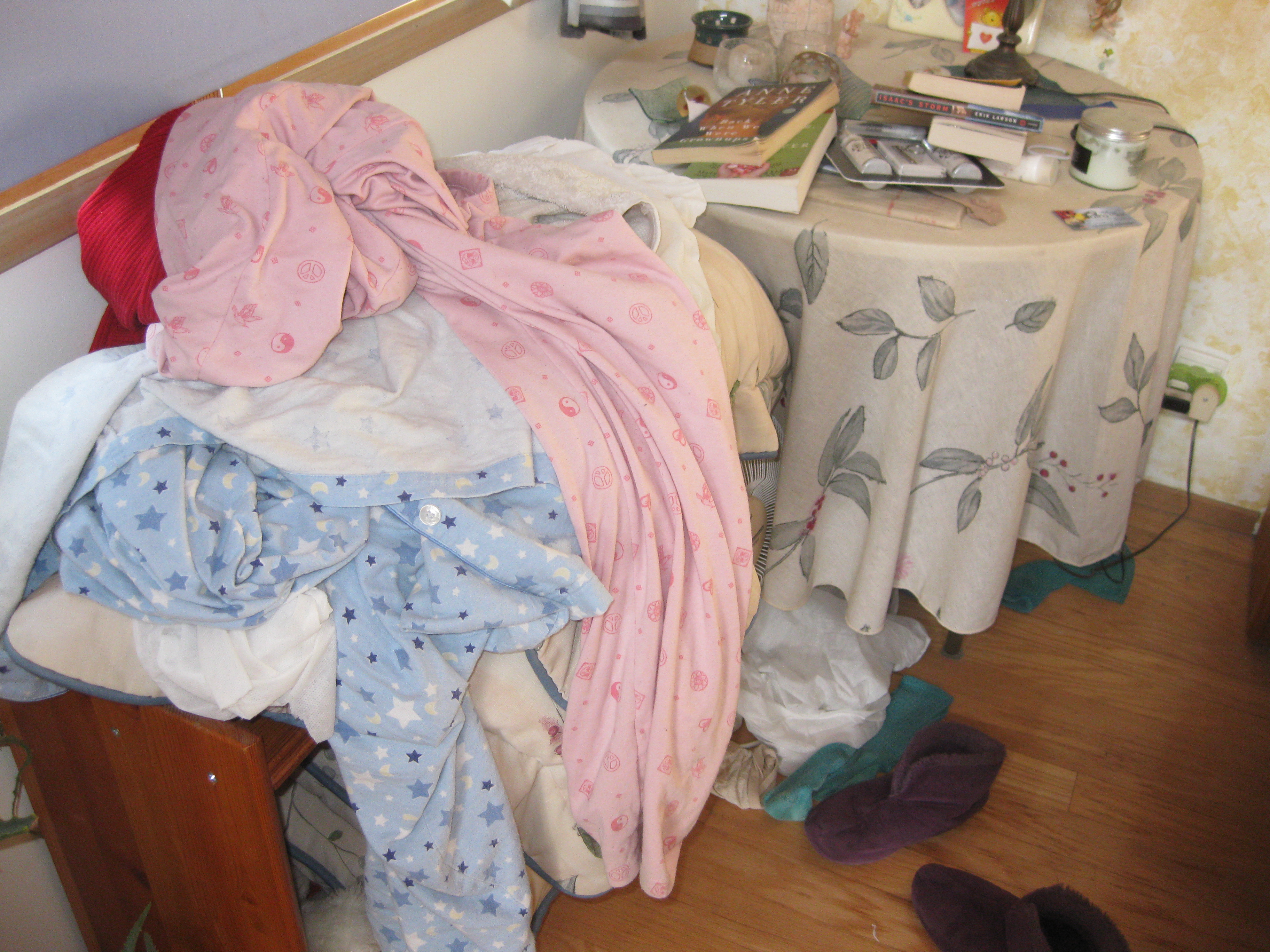
Clutter is an expression of unhappiness. When one’s things are managed in a haphazard way, the first thought should be “What am I unhappy about?” The answers can be surprising.

Causes of clutter

Perhaps the clutter comes from unhappiness about one’s choices—mate, work or profession, or simply one’s choices of possessions

Perhaps the clutter comes from unhappiness about the amount of stuff-too much stuff!

Perhaps the clutter comes from unhappiness about obligations—too many obligations to handle.

Perhaps the clutter comes from unhappiness about one’s current life presentation (in other words, the form of one’s daily life).

Perhaps the clutter comes from unhappiness about having more than one should—guilt over one’s excess gifted existence.

Perhaps the clutter comes from unhappiness about past choices made or past indecision.

Perhaps the clutter comes from unhappiness about the way in which spiritual .omnipotence meted out one’s circumstances.

Clutter is much bigger than it seems.

The cure for clutter

Since the causes are multi-layered, then so too is the cure. Choose one of these cures and if it only addresses parts of your issues, then choose another.

Cure #1: Consider your expectations of yourself. Consider your expectations of your past—did you expect too much from your caregivers or from other important people in your life? Forgive the caregivers who were too tired. Forgive yourself for taking on too much. Declutter one significant area, then observe this area and be proud and kind to yourself. Declutter a second significant area, then observe this area and be proud and kind to yourself. Continue in this fashion until you have decluttered the areas that deserve to be uplifting.

Cure #2: Write a list of all the choices you have made that have affected your clutter. Examine the list to gain insight. Keep the list in a place where you can see it regularly and address each item by decluttering the corresponding stuff. Continue in this fashion until you have decluttered the areas that deserve to be uplifting.

Cure #3: Join a close friend in a decluttering effort. Each of you discuss the choices that have led to your current state of unhappiness. Agree to a decluttering goal and either write it down and sign it or create a decluttering song that you can sing when you declutter your own stuff. Encourage one another. Feel kindly thoughts for the other when he or she succeeds in decluttering. Continue in this fashion until you have decluttered the areas that deserve to be uplifting.

Care for one’s possessions

In general, people living in modern open societies buy too many things. If you see that you cannot care for the things you own, consider relinquishing many of them. Also, if you find that you are spending a large percentage of your day caring for your possessions so that you are unable to meet with friends or family or are unable to give of your time for helping others, consider relinquishing the possessions that require too much care.

Hesitation

Post 11-Buttons     Screen beans-perception

Hesitation: wanting, but preventing action or decision because of fear, lack of information, or worry.

When a person hesitates about an action that must be performed immediately, precious time can be lost. When a person hesitates about an action that is not required, the results can be very different depending on whether the action would lead to betterment or negative results.  When a person hesitates because of fear, the same results can occur–different depending on whether the action would lead to betterment or negative results. Same goes for hesitation due to lack of information or worry–results that may be good or bad depending on the actions taken.

Hesitation is not necessarily a bad thing. If one’s intuition intuits that the action or decision will lead to negative results, best to follow that feeling. Intuition is the key ingredient when a sense of hesitation  is felt. On the other hand, people who consistently hesitate have most likely lost the ability to feel intuitive sensations and are simply performing habitual behavior.

To do

When you feel hesitant to take an action or make a decision, notice three things:

  • Does the action or decision make you feel fearful, worried, or unqualified to act/decide?
  • Does the action or decision cause your intuition to signal a strong response–positive or negative?
  • Does the action or decision require you to be more active than you normally would? If so, are you hesitating out of laziness or inertia?

Once these questions are addressed, a decision should be easier to make and an action should be easier to take. Rather than hesitate, be willing to involve, help, and join. But always be aware of side effects that could occur. Each decision and action has myriad side effects that can influence other decisions and actions.

Go!

Meetings in the conference room, meetings in the hall

Post 22-meetrings

The purpose of meetings

To coordinate, to forge agreement or competition, to mix personalities with expectations, to drive opportunity, to discourage chaos, to air opinions, to foster relationships, to control, to quash creativity, to encourage creativity, to educate, and to validate. To meet (visual and verbal exchanges).

Meetings have purpose and less so. Positive and negative energy. Positive and negative outcomes. Positive and negative feelings. Positive and negative interactions. Dual presentation depending on each participant’s motivation and position.

To meet

Many meanings, many interpretations. The main purpose of meetings is to bring together in order to change current reality. Sometimes for betterment of society and sometimes not. Each meeting is an opportunity for this or that.

Possibilities.

Overcoming small traumas

Oblio-post3Today I took my small, sometimes aggressive, male dog, named Oblio, for his morning walk. In my community, there is an area where dogs are walked unleashed. We usually walk early to avoid meeting other male dogs. Today we walked an hour later than usual. The walk was uneventful until I noticed an unattended large dog across the street and I thought he was an unaggressive dog who my dog has made peace with. I noticed Oblio eyeing this dog as well. Suddenly the owner appeared and I realized that the dog across the street is the one who is always tied up and who Oblio dislikes and vice versa. I won’t give all the details, but I managed to attach the leash on Oblio before anything unfortunate happened. They carried on their way and Oblio and I went our way.

After this “almost” event occurred, I noticed the following feelings in my body: overall tightness, quick breathing, queasiness in my stomach, and repeated thoughts about the possible dog fight.

I stopped a moment to receive spiritual assistance and I received the following information about what to do after a small trauma:

  • Notice the physical state of your body.
  • Breathe normally (breaths don’t have to be deep, but should not be quick).
  • Think about how things turned out more-or-less okay.
  • Do movements, like a little victory dance, which will release the bodily tension.

Non-release of trauma-induced reactions can lead to physical pains, anxiety and other negative emotional states, constricted behavior, and overall reduced balance. Release enables balance and better health.