A Balanced Approach to Wellness!

Posts tagged ‘Energy Guidance Complete’

Spiritual illness and its positive aspects


spiritual illness

Spiritual illness seems like a serious state of being, but in actuality, it is a positive predicament. Spiritual illness signals the need to clarify for oneself beliefs and convictions. When spiritual illness is approached as a wake-up call, it can be the first step towards more focused living.

Spiritual illness can lead to study about religious beliefs, study about spiritual lifestyles, study about earlier civilizations, and study about meditative practices. All studies that lead to increased spiritual connection are positive—as long as the study does not lead to a sense of right or to a belief that one’s chosen way is better than others.

Understanding the cause of the spiritual illness is helpful, and the cause can help determine the “cure”. Allowing the spirit to be ill is not harmful as long as the illness does not lead to depression. Spiritual illness is a call for change that can be realistic and immediate. The move from unwell to very well can be relatively quick.

The main step towards cure is understanding the cause of the illness. After that, the road to recovery is simply a belief away!

How contagious is spiritual illness?

Bad backSpiritual illness is like a bad back. Once it has been misaligned, the possibility for it to happen again exists. The person who ensures that his or her once-bad back stays supple has the likelihood of not suffering in the debilitating manner in the future.

Illness of the spirit aches like the aching back—with spasms of deep pain and hints of deep pain about to happen. The spirit aches for alignment, yet improper care weakens and undermines the foundation of spiritual sustenance. Then when spiritual belief is challenged, the spirit gives way and illness sets in with spasms of deep pain and hints of deep pain about to happen. Spiritual care heals the aching spirit, and future work strengthens it.

Spiritual illness is contagious like the bad back. Watching someone suffer causes fear, which can weaken the foundation of balance. Or it can cause warning, which encourages some to strengthen the foundation of balance. For relatives of the sufferer, the spiritual illness can teach bad habits or inspire searching for support.

Spiritual illness is surmountable with desire to heal, desire to open, and desire to connect.

How spiritual illness is seasoned

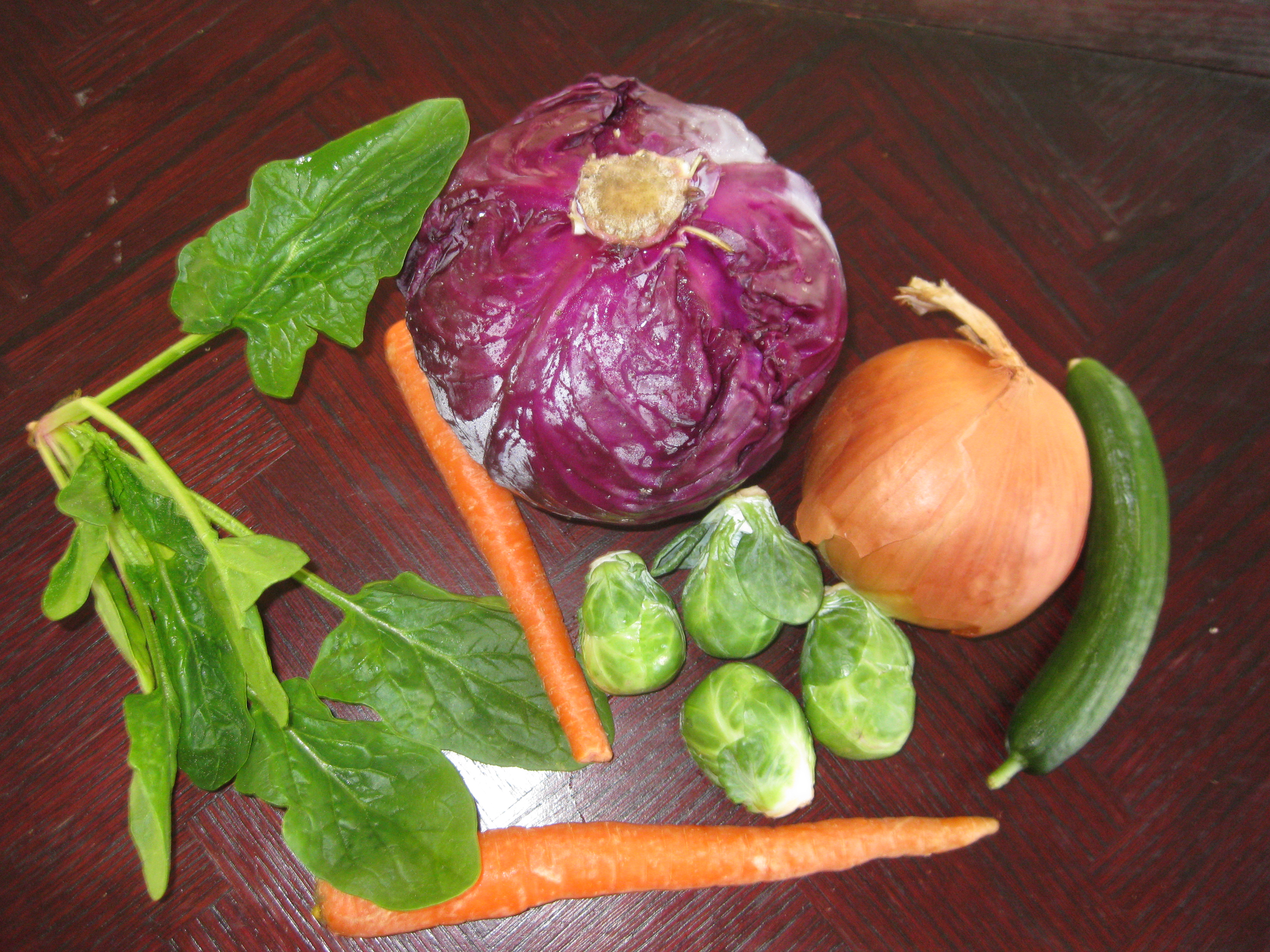
Post 104-veggies.jpg

Think of spiritual illness as a sauce. A bit too much of one spice and the sauce becomes unpalatable. Too much of all the spices and the sauce becomes overtaken.

When spiritual illness is brewing, the balance of decisions and actions is important. Too many wasteful and waste-producing activities tip the balance towards illness. Activities that revive the sense of connection tip the balance towards fine.

Spiritual health, like the spices of a dish, is one component of health. The other components: physical health, emotional health, and intellectual health are the more obvious aspects of health, but without the spicing the meal stays unimaginative. The spicing causes the meal to ignite the appetite, interest the taste buds, and involve the memory. So too with spiritual health.

A sense of spiritual connection ignites the imagination. A sense of spiritual guidance interests the thoughts. A sense of spiritual longing passes from generation to generation. The seasoning of the life is rich and satisfying.

Spiritual illness can occur “when spiritual questioning causes imbalance that the body cannot fathom.”  (see https://energy-guidance-complete.com/2015/06/24/spiritual-illness-strikes/) Spiritual pondering is a normal part of spiritual health, but when pondering becomes denying or when viewpoint is viewed as supreme, spiritual illness takes hold. The spicing becomes cloying or too intense, and the struggle to continue is magnified.

Seasoning is done through trial and error and through following those who tried before. Seasoning can be the best aspects of a dish or the worst. Spiritual health can raise up the life and spiritual illness can sink the life. Finding balance is necessary for fulfilling and joyous living.

When society suffers from spiritual illness

imbalanceSpiritual illness can be felt at many levels. When society suffers from spiritual illness, the effects leave imprints on all the members. The individual members of society have varying amounts of damage depending on their own spiritual balance.

A society that suffers from spiritual illness exhibits any or all of the following symptoms:

  • Society members mistreat other members because of inflated sense of right.
  • Society members mistreat other members because of inflated sense of deservedness.
  • Society members mistreat other members because of inflated sense of self.
  • Laws unfairly advantage members who believe they deserve more.
  • Society members consider the feelings of buildings over the feelings of other living things.
  • Society members relinquish responsibility for their own actions.
  • Society members absolve themselves of responsibility for extending themselves.

When society suffers from spiritual illness, each member feels the effects, no matter their role in perpetuating the spiritual illness.

Spiritual illness strikes!

spiritual illness

This past week, I suffered from a bout of spiritual illness. My body gave way, and I gave in. For days I rested and let my body restore itself to health. During that time I pondered the causes, the cures, and the symptoms. During that time, Spiritual Presence quieted, leaving me to wonder what the purpose was for my suffering.

I was ill, but not very ill. I had a fever, but no other symptoms. I lost my appetite, but gained enhanced senses of taste and smell. I asked Spiritual Presence questions throughout, slowly coming to an understanding as I experienced my body’s struggle.

Spiritual illness is illness that blows in when spiritual questioning causes imbalance that the body cannot fathom. Spiritual illness affects people who face questioning or attack at the spiritual level. The questioning can be internal or from other people. Even a person who is strong in his or her beliefs can suffer spiritual illness when outside influences overtax the framework of belief.

Recognizing spiritual illness is difficult because other symptoms can cloud its existence. Treating the body for non-spiritual causes will not balance the spiritual imbalance. The balancing work requires efforts that go beyond normal healing.

Having awareness of the cause is the first step. Subsequent steps could include ruling out—and treating—physical or emotional causes. Examining one’s spiritual beliefs can be another step.

Awareness of the importance of spiritual balance is needed for full body-soul balance.

Place Worship

place

Places are called holy because of people decisions. The holy places become symbols for future generations and they assume greater or lesser importance depending upon stories. The stories and the legends that develop around holy places change the places from just places to symbols.

When the symbols become associated with national identity or with religious identification, they can be overly important. A place is a place. It might be beautiful from natural sources or from human artistry, but it is still just a place. No more holy than the places nearby.

(This post is dedicated to my son Matan, who understood this wisdom from a young age.)

The way to diet

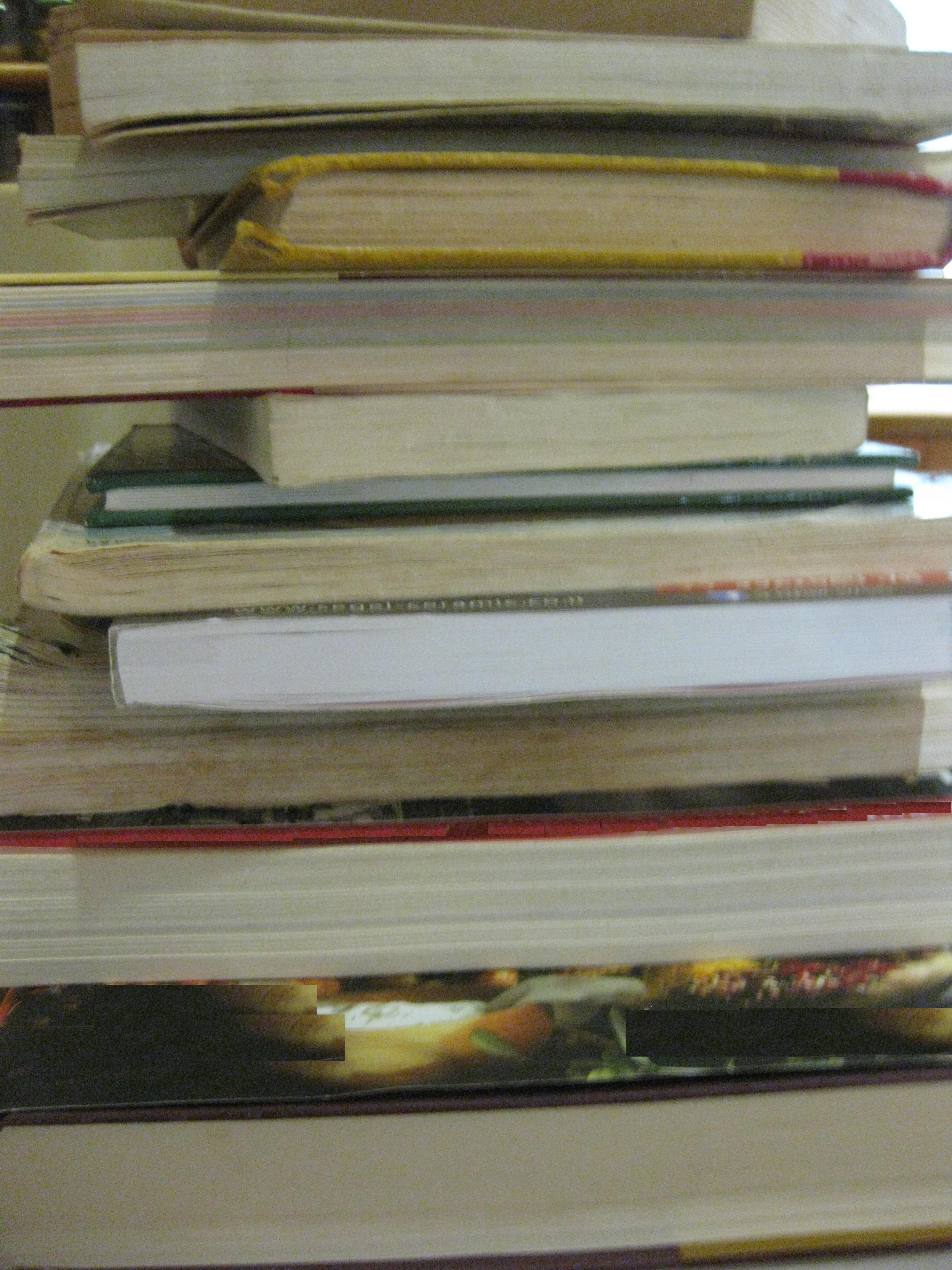
Diet books-tower of confusion

The world of dieting is fraught with quick-results claims and misinformation. Diets work for those who build an individualized plan, not through following the latest fad diet, but through understanding of food and its role in nourishing the body.

Moderation is the foundation of proper eating. Eating whole and nutritious foods builds on the foundation.

Here is a poem that will appear in the future book of poetry “Growth”:

Diet books-tower of confusion poem

Thankfulness with Trenta

Thankfulness

Trenta is the large sized drink at Starbucks. Why is it used here? Because largeness is what we want when we’re being thankful. Largeness in feeling and largeness in expression!

Here are ways to add large sized thankfulness into your life:

  • Add an Appreciation ritual to your eating. Consider all the people who contributed to your meal, from the people who worked in the fields harvesting the vegetables to the people who worked in the store or restaurant packaging the food or working the cash register. If your meal includes meat or dairy, consider the animals who gave their lives or milk for your nourishment.
  • Add Appreciation of Abode into your weekly or daily schedule. This ritual can include going from room to room expressing thankfulness for the people who use these rooms or for the rooms themselves. This ritual can include looking at your home/apartment/tent from the outside and expressing thankfulness for the whole structure.
  • Add “How wondrous is the sky” thankfulness to your daily routine. The first time you go outside, even if it’s just to quickly walk to your car, look at the sky and express thankfulness for it. Even if it’s raining or too hot.

Many more rituals can be added to your thankfulness quest:

  • Considering the majesty of your body each time you go to the bathroom is one way.
  • A daily Rising and/or Retiring ritual to start and end your day with thankfulness is balancing.
  • Every time you choose a decorative item for your home (like a rug or a vase) or for your body (like an article of clothing or shoes), quietly give thanks that you have the ability to choose.
  • On each birthday, consider the previous year and give thanks for all that happened in it—even the less good things. Then give thanks in advance for the coming year.

There are so, so many ways to add trenta thankfulness into your life. Remember: the larger, the more effective!

Life as a page

Blank page

“A blank page. Each person’s life when just starting out is like a blank page. Some pages never get filled. Some pages get filled partially. Some pages are SO full of interactions, questions, adventures, accomplishments, failures, starts, stops, and attempts. Some pages are full of starts, stops and attempts, starts, stops and attempts, starts, stops and attempts. Some pages have tentative actions while others have decisiveness. Some pages contain laughter and joy. Some pages, only sadness and disappointment. Most pages have a bit of this and a bit of that, but they don’t have as much as they should of BALANCE, PURPOSE, and SUBSTANCE.”

From the Introduction to Oneself-Living

Life can be viewed in many ways. Seeing it as a blank page allows for creativity and possibility. Filling the page with color and poetry and formulas and shapes and adventure logs and so much more. Or filling it with lists of “can’ts” over and over. A blank page allows each person to make their life into a personal story that is captivating in its uniqueness.

A blank page is what we get at birth. A life that ends too quickly can still be filled with creativity and possibility if the person fills it so. A life that is long can be empty of creativity and possibility if the person fills it so. The filling of the page is important. The color comes from interaction with others and with Spirit. The poetry comes from moments of connection. The formulas come from learning and striving. The shapes come from self-awareness and self-expression. The adventure logs recount life travels, the good and bad, as life develops.

Filling the page with oneself makes the most sense. Not filling it with what others want, but with what you want. What you want…

Each person has a separate page. A separate blank page. It’s never too late to add color, poetry, formulas, and shapes.

Connection with Spiritual Connection

Spiritual connection

Spiritual connection surrounds all that we do. When we are doubtful of ourselves, spiritual connection is urging us to be supportive. Spiritual connection supports our actions, and we have to support them too.

When efforts seem wasted and quitting feels close, we must reach for the connection and let it support.

I’m writing wisdom poetry about faith. Here is a quote from the poem:

The opening to
Oneself is the
Opening to Spirit. Within oneself
Is the connection
Through the soul. For the soul
Yes the soul
Is Spirit derived. The soul
Carries energy that is
Spirit derived.

The opening to
Oneself is
Opening to Spirit. Opening to Spirit
Through self-inspection.
Finding the connection.
Finding the soul.

+ When you find your soul, you will be
open to Spirit.

And another quote from the poem:

The soul
Opens the living being
To spiritual energy.

The soul
Bridges the gap
Between beyond
And grounded.

Relaxation in soulful connection
Is natural and possible. Soulful connection
Brings relaxed being. Relaxed being is
Floating in thoughts of
Acceptance and connection. At
Connection is release from
Hurtful self-affliction. At
Connection is release
From criticism.
Relaxed being is floating in thoughts
While firmly attached to physicality.

The blood still flows.
The digestion continues on.
The nerves sense stimulation.
The breathing continues.
The body remains firmly established.

Connection is through physicality transcended
And thoughts receiving the body’s strength.

Connection is through thoughts a-soaring
Through flesh and blood aligning
And activation from soulful assistance.

And from the poem’s conclusion:

Connection to Spirit,
Sacred connection
Many paths and many offerings.
The connection has resonance
The connection uplifts the life.

Connection to Spirit,
Continuing connection
Many forms and many presentations.
The connection shares wonder
The connection inspires the life.

Eating Through Entitlement

Post 100-foods

Food is the substance that we all require to keep our bodies alive and functioning. Eating provides the way for food to enter our bodies. Eating is basic survival.

Eating through entitlement is eating that is beyond survival concerns. It is eating for fun or for reward or for companionship or for something to do. Entitlement eating concerns itself with taste, texture, and self-satisfaction. Entitlement eating relates not to hunger, but to the right to enjoy the food beyond its nutritional purpose.

Choosing a sweetened cereal for breakfast rather than oatmeal is an example of entitlement eating. Choosing salmon/veal for dinner rather than eggs/a bean dish is entitlement eating. Choosing a cappuccino frappe with extra whipped cream rather than black tea is entitlement eating. Eating three pieces of a delicious tasting pastry that lacks nutritional worth is entitlement eating. Eating a triple patty hamburger rather than a single patty hamburger is entitlement eating.

Creating tasty meals that are attractive and nutritious is not entitlement eating. Eating more of the tasty meals after hunger is sated is entitlement eating. Eating birthday cake is entitlement eating; however, eating it at a celebration with family and friends is positively received (unless too much is eaten).

Eating through entitlement.

Entitlement is part of our normal eating experience. Modern food production has enabled it to be so. Entitlement eating is very present, from the poor to the rich, in varying amounts of wastefulness.

There are ways to eat through the entitlement, that is, to eat without expecting the food to be more than the survival substance that it is. These changes in eating habits and in attitude can lead to better health and well-being.

  • Consider the healthful aspects of the foods you eat and change how you view the healthful foods.
  • Eat portions that fill but don’t stuff. (I use a salad-size plate at all meals to help me eat less.)
  • When you eat, look at your food and smile, and then think a thankful thought about it.
  • When you eat, notice the foods—their texture, their taste, their aromas, and their ability to satisfy your appetite. Even foods that have little nutritional value—notice them.
  • At events where food is served according to demand, like at buffets, fill your plate once and resist a second visit to the food.
  • Think of yourself as a person who eats to survive and then enjoy your food.

You can be a foodie and release the entitlement. By appreciating the foods you eat and by eating the amount that suits your age, sex, and activity level, you can enjoy the magic of food!

The Head Signals: Migraines

headache

Migraines are the body’s way of signaling for help. They are front-line announcers of distress. A person who ignores other bodily signals will usually get migraines.

Migraines are not genetically transmitted, but they can be learned. A child whose parent experiences migraines on a regular basis learns migraine behavior. That doesn’t mean the child will suffer with migraines, but the child feels the effects in a subtle—or not so subtle—way which transmits migraine behavior as a coping mechanism.

Migraines signal that shutting down is necessary for the body to recoup its equilibrium. The shutting down is a response to lack of sleep or lack of water or too much visual stimulation or too little self-care or irritation by overhead lighting or lighting on the computer or emotional confusion. Improper food intake can contribute to migraines as can seasonal changes. Each person experiences life in a unique-to-me way; therefore, the causes and contributors to migraines are different for each person. There are many more reasons for migraines to occur and my partial list is to give a sense of migraine triggers.

Migraines require care. Dulling them is not care, it is foolhardy. Yes, feeling less pain is better, but it is temporary relief until the next one and the next one and the next one and the next one. Migraines require examination of lifestyle and life choices. Migraines require changing routines and changing lights (if lighting is a cause).

Relief from migraines is worth the investment in removing the migraine causes and contributors. Not only will migraines lessen, but other aspects of health will improve.

Natural death

Post 27-striving

This blog post is from Exploring Energy Guidance Complete, My Journey.

“Natural death, through illness or disease, body mis-function, or aging, causes people to struggle with sadness, anger, relief, confusion.” The process of living and dying is considered in the chapter “Concrete Living” in Oneself—Living.

My mother died from metastasized cancer when she was 66 years old. She had cancer of the sinuses that metastasized to her lungs. She was 55 when the sinus cancer was diagnosed. She underwent radical surgery to remove the cancerous growth, which left her disfigured and disabled. Her life was dramatically changed, yet she still had life. Her slow decline was difficult for her and for our family.

When she died, we struggled with sadness, anger, and confusion. There was no relief. No matter how much she suffered, we wanted her with us. The letting-go was fought. We fought to make her stay and we fought to not let her go. Our efforts made her leaving harder for her, and she tried to hang on when she needed to let go.

The dying process is one in which the person who is dying is affected by those around.  Children, siblings, partner, parents, friends, and even acquaintances cause pull in the wave that is taking the life-leaving-person out to sea. Death is like the sea and each person like a small living object on the shore living life and fighting the draw of the waves. Shelters can be built and the inevitable can be ignored, but the process moves on naturally and ever distressingly. Life, like death, flows and ebbs, bringing new circumstances and similar challenges.

The dying process ends one life and begins the after-life processing of the soul. The after-life processing of the soul connects the people who were left with the one who left. Through openness, desire, and intuition, the soulful essence of the one who left can be felt. The dying creates a different reality that can be a continuation of the relationship at the soulful level. Knowing this information does not lessen the pain of losing a loved one, but it can make the moving on easier.

To purchase Exploring Energy Guidance Complete, My Journey, go to http://amzn.com/1508539715


Entertainment through performance

Post 107-entertainment

Music, art, slapstick, drama, literature, dance, and other forms of entertainment.  All are created by people for people. Experiencing entertainment is soul-fulfilling. Creating entertainment is soul exercise because the soul requires the stretch of the imagination and the melody of the breeze. Any form of entertainment that is awakening for the soul is soul exercise.

From the book of poetry, Unfolding:

The Small Theater

      Movies, plays, and artistic performances
Blossom at the small theater.

      Audience interactions—
Among themselves and with the performance,
Creating a shared sense of experience,
A shared sense of time.

The small theater.
Calling people out of their homes.
Providing opportunity to interact,
Providing opportunity to connect.

Entertainment is naturally built-in. People are drawn to others’ antics. People are drawn to others’ doings. The soul wants entertainment, and the best way to get it is to be entertaining. To oneself and to others!

Excavating my soul color

parachute From Awaiting Light—Understanding the Development of the Soul, I learned that the soul has color which is bestowed at birth. The soul color has four attributes that determine our interests, our affinity for certain times of the day, seasons and temperatures, our emotional reactions, and our family connections, among others.

I’m currently writing a wisdom poem about faith, and in it the importance of knowing soul color is raised. By knowing one’s own soul color, a person can ascend towards spiritual connection through the power of the soul. Without knowing one’s soul color, the connection is difficult to create.

(A reminder about wisdom poetry: “A wisdom poem is a poem that is dictated directly from Spiritual Presence.” …from Unfolding.)

Today I excavated my soul color. I reviewed the explanations about soul color attributes in Awaiting Light, and then I dug deep to understand who I am, what are my real interests, what is my natural pace, and so on. I had to think back to my childhood and remember the things that drew my interest. I had to consider my true self and not the self that was molded by my parents and my society.

I considered the colors that appeal to me, shapes and metals too. I thought about activities that draw me, movements that energize me, and sounds that soothe or inspire me. I focused on scents that make me smile and on animals that make me feel friendly. I considered taste preferences and textures. I remembered moments that seemed soul-filled and people exchanges that felt fulfilling. I breathed deeply and felt the sense sensations that bring satisfaction and grounding.

After I made my long list of items that correspond to soul color attributes, I consulted with Spiritual Presence. A few things that felt natural were actually coping mechanisms from childhood so I took them off the list. Coping mechanisms can be deeply rooted, but they are not part of the soul.

Knowing my soul color can help me make choices and decisions that suit who I am—deep down in my soul.

To understand more about soul color, read this blog post: https://energy-guidance-complete.com/2014/08/04/the-color-of-your-soul/

To learn more about soul color and the soul, buy Awaiting Light: http://amzn.com/1500504084

Body talk and the meaning, part 2

PeopleA pain in one part of the body is often related to that part of the body, but not always.  The body is a complete entity, and what happens in one part can have an effect on many other parts. Illness and afflictions have causes, causes that are often not easy to understand.

An example is fibromyalgia. Fibromyalgia syndrome is not understood because it acts differently in each body. There are many hypotheses as to the cause and some of the hypotheses are accurate for some people. But not for all, which make it a confusion. Each person with fibromyalgic symptoms has reasons for the symptoms, the reasons are body talk unheeded.  Each person with fibromyalgia syndrome suffers from body talk unheeded that multiplied because of ignored messages. When the body is trying to communicate and the person doesn’t listen the body will shut down, overreact, or take over. Fibromyalgia syndrome is an example of the body doing all three.

Whether the cause of illness or afflicitons is a physical cause or an emotional cause, the body will speak to you.  If you listen and work out the cause, your body will reward you with well-being and reliability. If you ignore the whispers and the shouts, your body may lose its ability to communicate which can lead to many ill effects.

The next time your body calls, aim to listen carefully. You will be grateful in the future.

More about body talk: Body talk and the meaning

Body talk and the meaning

painA rumble in the tummy? Body talk for hunger, fright, or contentment.

Pain in the lower abdomen? Body talk for “you ate something that wasn’t good for you”,  “you did a movement that you weren’t ready for”, or “you contracted a stomach bug—get to the toilet!” (among other possibilities).

Lightness in the head? Body talk for lack of sleep, lack of water, lack of nourishing food.

Pain the toes? Body talk for “your shoes don’t fit”, “there’s a splinter” or “you have an inflammation in your nose (or mouth or somewhere other than your toes)”.

A pain in one part of the body is often related to that part of the body, but not always.  If the pain in the toes is caused by an inflammation somewhere else in the body, no amount of focus on the toes is going to help until the inflammation is handled. The body is a complete entity, and what happens in one part can have an effect on many other parts.

Whether the cause of pain or irritation is a physical cause or an emotional cause, the body will speak to you.  If you listen and work out the cause, your body will reward you with well-being and reliability. If you ignore the whispers and the shouts, your body may lose its ability to communicate which can lead to many ill effects.

The next time your body calls, aim to listen carefully. You will be grateful in the future.

More about body talk: Body talk and the meaning, part 2

Wisdom poetry is wondrous!

Post 25 LogoThis blog post is too early, but I’m so excited that I can’t keep quiet. I am almost finished with another book of poetry that is so amazing to me that I can’t not shout about it!

Poem-dig deep

Can you guess what I’m writing about?

The fascination with food fads

liquids

Food fads create interesting news stories and limitless conversations. “This food is a super food!” or “This food is the answer to your health problems!”.  “This diet will bring you your dream life!” or “This diet will help you feel younger!”. “This supplement will cure you of <fill in the blank>!” or “This supplement suppresses your appetite so you can lose weight easily!”.  “ By following this regimen you can live longer, lose weight faster, or eat all your favorite foods!”

So go the food-fad claims.

The true food rule is moderation. Eating in moderation is the key to healthful eating. Even if you eat a food that is un-nourishing, as long as you eat a small amount, it will not cause harm.

Moderation is discussed in Oneself—Living:

“Moderation is actually fascinating! No easy feat is moderation. It requires attention and control and vigilance. And sometimes, rethinking and reworking. Moderation is the pinnacle of conscientious living. Moderation contributes to self-control, which in turn brings balance. The more one lives in moderation, the more one can accomplish.

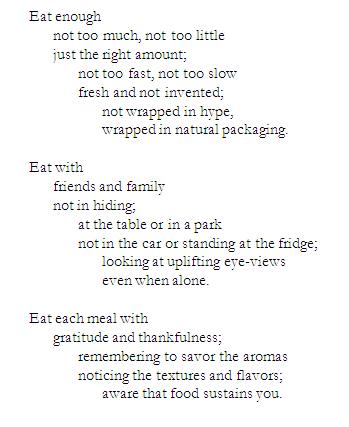
Regarding eating, moderate eating provides the appropriate amount of fuel to run the body. Not too much, not too little. Moderate eating leads to enjoyment of food and to better digestion. Food that is not ejected or is not over-consumed is food well used. Food that is eaten for sustenance is food well used. Food that is eaten, not only in the correct amounts, but also in nourishing environments, nourishes the body and the soul. Soulful eating. Soul-fulfilling nourishment. Nourishing the soul includes the body’s nourishment. Enjoying the food, appreciating the food, understanding that food is for energy, all connect to elevate the process of caring for the body.

Paying attention to the amounts of food eaten, to the atmosphere in which the food is eaten, and to the quality of the food lead to well-being and elevated living. Moderate eating and eating atmosphere are presented in the book of poetry, Unfolding:

Poem-eating

Food fads are simply fads. Moderate eating is for a lifetime!

To buy Oneself—Living: http://amzn.com/1495289451

To buy Unfolding: http://amzn.com/1508828229

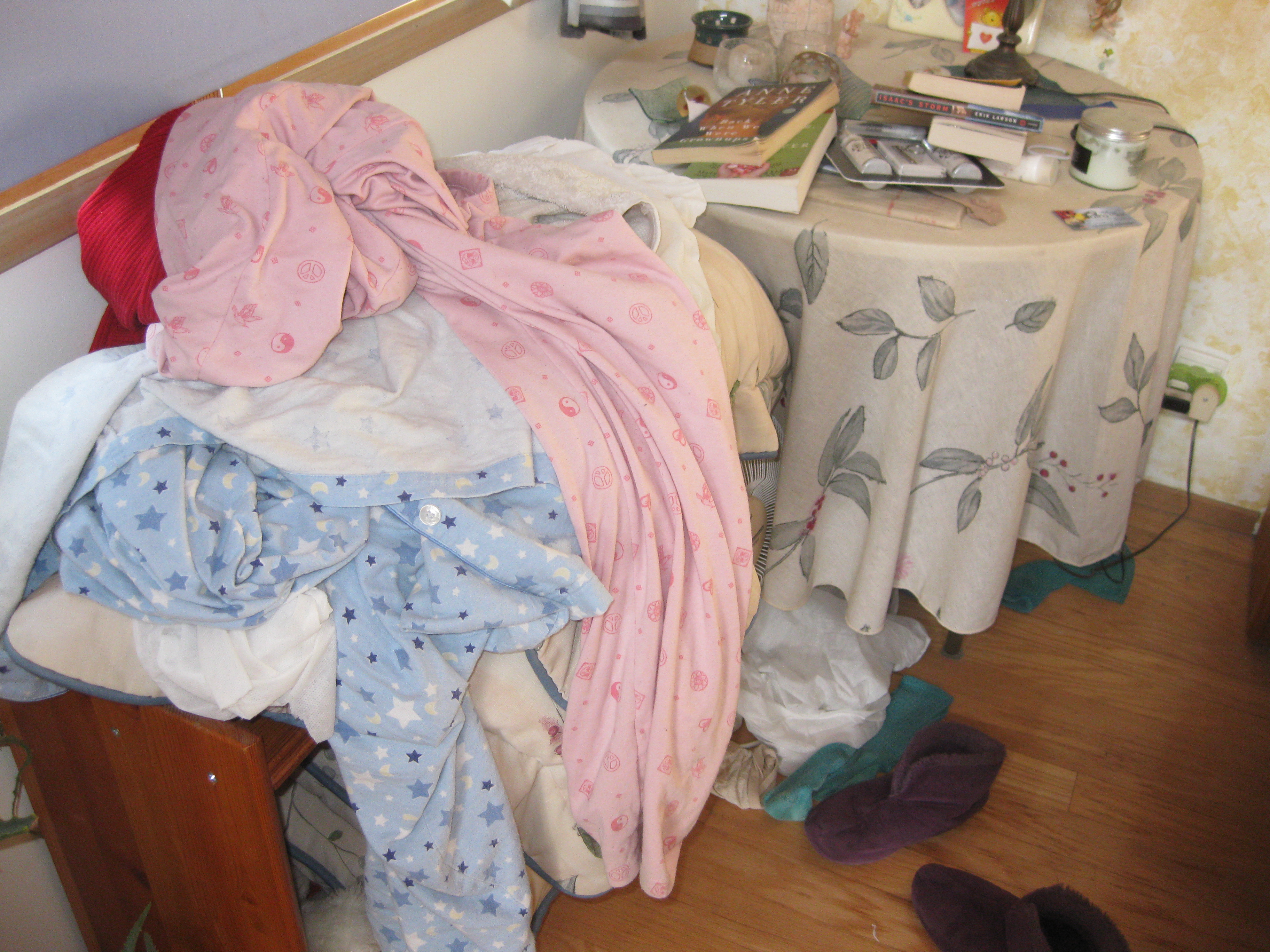
Clutter

Clutter

(This blog post was posted over a year ago. I’ve been in some cluttered homes lately [including my own] and I’ve been prompted to remind everyone about the importance of unclutter. Happy decluttering!)

Clutter is an expression of unhappiness. When one’s things are managed in a haphazard way, the first thought should be “What am I unhappy about?” The answers can be surprising.

Causes of clutter

Perhaps the clutter comes from unhappiness about one’s choices—mate, work or profession, or simply one’s choices of possessions

Perhaps the clutter comes from unhappiness about the amount of stuff-too much stuff!

Perhaps the clutter comes from unhappiness about obligations—too many obligations to handle.

Perhaps the clutter comes from unhappiness about one’s current life presentation (in other words, the form of one’s daily life).

Perhaps the clutter comes from unhappiness about having more than one should—guilt over one’s excess gifted existence.

Perhaps the clutter comes from unhappiness about past choices made or past indecision.

Perhaps the clutter comes from unhappiness about the way in which spiritual .omnipotence meted out one’s circumstances.

Clutter is much bigger than it seems.

The cure for clutter

Since the causes are multi-layered, then so too is the cure. Choose one of these cures and if it only addresses parts of your issues, then choose another.

Cure #1: Consider your expectations of yourself. Consider your expectations of your past—did you expect too much from your caregivers or from other important people in your life? Forgive the caregivers who were too tired. Forgive yourself for taking on too much. Declutter one significant area, then observe this area and be proud and kind to yourself. Declutter a second significant area, then observe this area and be proud and kind to yourself. Continue in this fashion until you have decluttered the areas that deserve to be uplifting.

Cure #2: Write a list of all the choices you have made that have affected your clutter. Examine the list to gain insight. Keep the list in a place where you can see it regularly and address each item by decluttering the corresponding stuff. Continue in this fashion until you have decluttered the areas that deserve to be uplifting.

Cure #3: Join a close friend in a decluttering effort. Each of you discuss the choices that have led to your current state of unhappiness. Agree to a decluttering goal and either write it down and sign it or create a decluttering song that you can sing when you declutter your own stuff. Encourage one another. Feel kindly thoughts for the other when he or she succeeds in decluttering. Continue in this fashion until you have decluttered the areas that deserve to be uplifting.

Care for one’s possessions

In general, people living in modern open societies buy too many things. If you see that you cannot care for the things you own, consider relinquishing many of them. Also, if you find that you are spending a large percentage of your day caring for your possessions so that you are unable to meet with friends or family or are unable to give of your time for helping others, consider relinquishing the possessions that require too much care.