A Balanced Approach to Wellness!

liquids

Food fads create interesting news stories and limitless conversations. “This food is a super food!” or “This food is the answer to your health problems!”.  “This diet will bring you your dream life!” or “This diet will help you feel younger!”. “This supplement will cure you of <fill in the blank>!” or “This supplement suppresses your appetite so you can lose weight easily!”.  “ By following this regimen you can live longer, lose weight faster, or eat all your favorite foods!”

So go the food-fad claims.

The true food rule is moderation. Eating in moderation is the key to healthful eating. Even if you eat a food that is un-nourishing, as long as you eat a small amount, it will not cause harm.

Moderation is discussed in Oneself—Living:

“Moderation is actually fascinating! No easy feat is moderation. It requires attention and control and vigilance. And sometimes, rethinking and reworking. Moderation is the pinnacle of conscientious living. Moderation contributes to self-control, which in turn brings balance. The more one lives in moderation, the more one can accomplish.

Regarding eating, moderate eating provides the appropriate amount of fuel to run the body. Not too much, not too little. Moderate eating leads to enjoyment of food and to better digestion. Food that is not ejected or is not over-consumed is food well used. Food that is eaten for sustenance is food well used. Food that is eaten, not only in the correct amounts, but also in nourishing environments, nourishes the body and the soul. Soulful eating. Soul-fulfilling nourishment. Nourishing the soul includes the body’s nourishment. Enjoying the food, appreciating the food, understanding that food is for energy, all connect to elevate the process of caring for the body.

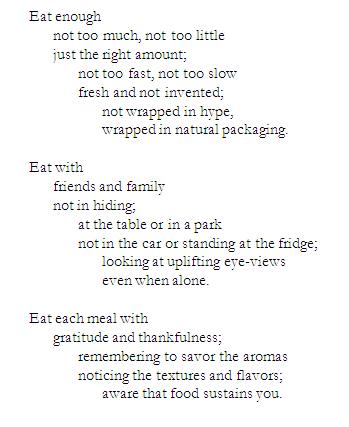
Paying attention to the amounts of food eaten, to the atmosphere in which the food is eaten, and to the quality of the food lead to well-being and elevated living. Moderate eating and eating atmosphere are presented in the book of poetry, Unfolding:

Poem-eating

Food fads are simply fads. Moderate eating is for a lifetime!

To buy Oneself—Living: http://amzn.com/1495289451

To buy Unfolding: http://amzn.com/1508828229

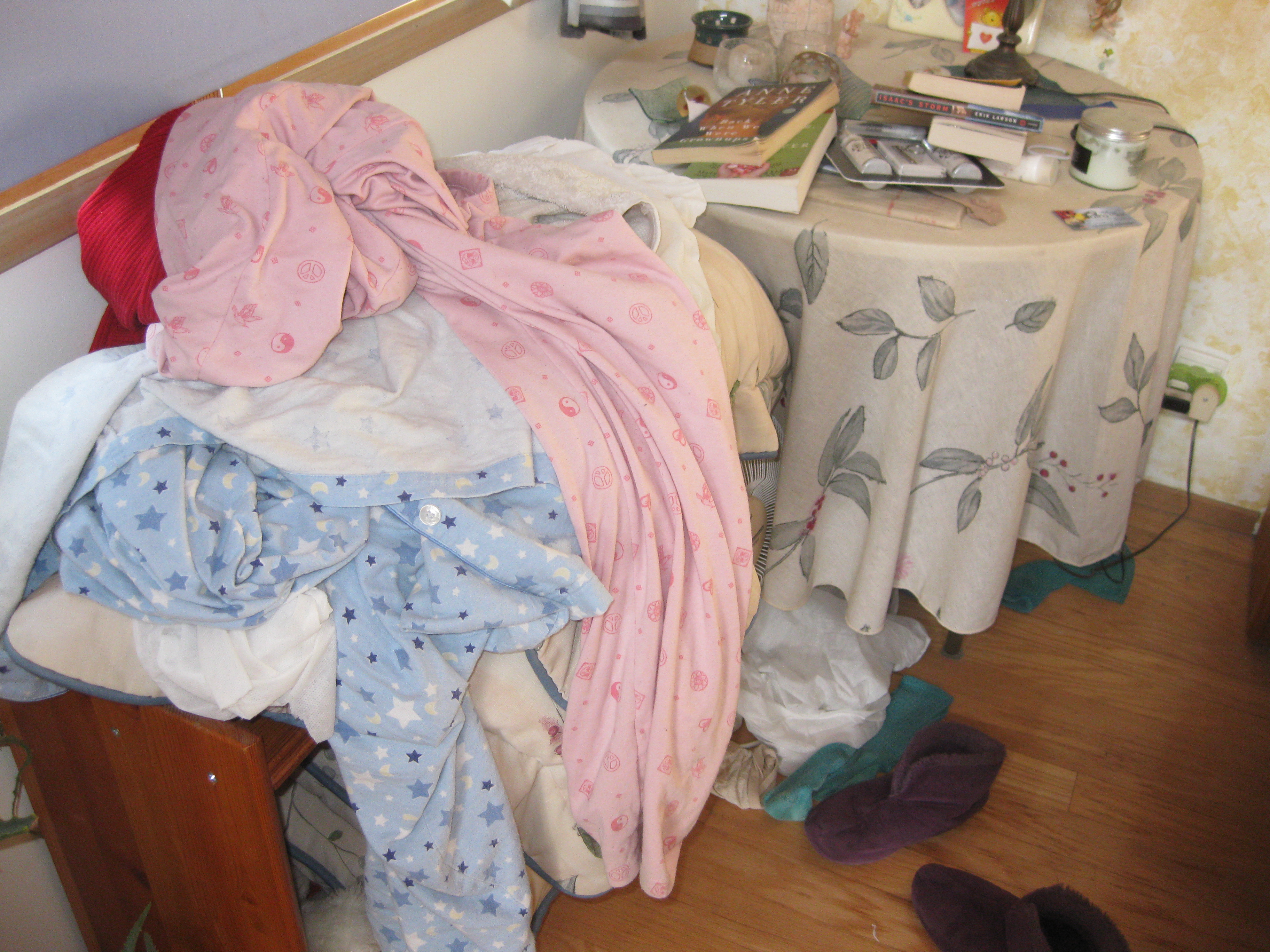
Clutter

Clutter

(This blog post was posted over a year ago. I’ve been in some cluttered homes lately [including my own] and I’ve been prompted to remind everyone about the importance of unclutter. Happy decluttering!)

Clutter is an expression of unhappiness. When one’s things are managed in a haphazard way, the first thought should be “What am I unhappy about?” The answers can be surprising.

Causes of clutter

Perhaps the clutter comes from unhappiness about one’s choices—mate, work or profession, or simply one’s choices of possessions

Perhaps the clutter comes from unhappiness about the amount of stuff-too much stuff!

Perhaps the clutter comes from unhappiness about obligations—too many obligations to handle.

Perhaps the clutter comes from unhappiness about one’s current life presentation (in other words, the form of one’s daily life).

Perhaps the clutter comes from unhappiness about having more than one should—guilt over one’s excess gifted existence.

Perhaps the clutter comes from unhappiness about past choices made or past indecision.

Perhaps the clutter comes from unhappiness about the way in which spiritual .omnipotence meted out one’s circumstances.

Clutter is much bigger than it seems.

The cure for clutter

Since the causes are multi-layered, then so too is the cure. Choose one of these cures and if it only addresses parts of your issues, then choose another.

Cure #1: Consider your expectations of yourself. Consider your expectations of your past—did you expect too much from your caregivers or from other important people in your life? Forgive the caregivers who were too tired. Forgive yourself for taking on too much. Declutter one significant area, then observe this area and be proud and kind to yourself. Declutter a second significant area, then observe this area and be proud and kind to yourself. Continue in this fashion until you have decluttered the areas that deserve to be uplifting.

Cure #2: Write a list of all the choices you have made that have affected your clutter. Examine the list to gain insight. Keep the list in a place where you can see it regularly and address each item by decluttering the corresponding stuff. Continue in this fashion until you have decluttered the areas that deserve to be uplifting.

Cure #3: Join a close friend in a decluttering effort. Each of you discuss the choices that have led to your current state of unhappiness. Agree to a decluttering goal and either write it down and sign it or create a decluttering song that you can sing when you declutter your own stuff. Encourage one another. Feel kindly thoughts for the other when he or she succeeds in decluttering. Continue in this fashion until you have decluttered the areas that deserve to be uplifting.

Care for one’s possessions

In general, people living in modern open societies buy too many things. If you see that you cannot care for the things you own, consider relinquishing many of them. Also, if you find that you are spending a large percentage of your day caring for your possessions so that you are unable to meet with friends or family or are unable to give of your time for helping others, consider relinquishing the possessions that require too much care.

Attitude

ATTITUDE influences when opportunity presents possibilities or barriers.

Possibilities or barriers? These words reflect the attitude.  Possibilities are attitude contributing. Barriers are attitude constricting. Society does not always present possibilities to its residents; however, when actual barriers are not in the way, attitude can prevail.

ATTITUDE is subjective. One person lies in bed all day because of a sprained toe. Another person is out and about even when unable to move both legs because of paralysis. Others pity themselves because of difficult relationships. Someone else forges ahead with friendships after having outlived most friends and family. People strive or don’t strive when presented with the same situations. Subjective ATTITUDE.

ATTITUDE is the attribute that interprets and influences responses, behavior, and subsequent decisions and actions. It interprets the daily happenings and it creates the subsequent reality.

ATTITUDE truly is a choice.

To see the world with eyes of gratitude is to see the small and large contributions of nature’s creatures (including people). To experience the world with appreciative intention is to experience majesty. To move through the day with vibrant life force is to feel the full offering that living presents. The world according to ATTITUDE!

Suffering-no

SUFFERING appears when expectations are unrealistic.

Expectations of life lived with ease and conveniences are expectations of life for china dolls in a display case. Ease and convenience are available, but they are subjective components of life. Ease is not real life. Ease is obtained after much investment in tasks and trials. Convenience has become Want number 1, with a focus on as little investment in energy as possible. Ease and convenience are possible, but when they are expectations of daily life, the appearance of SUFFERING is increased.

SUFFERING is subjective. One person suffers when  social  engagements are erratic. Another person suffers when a sneeze interrupts the train of thought. Another suffers when a meal is too boring. Someone else suffers because sleep is disturbed by the urge to urinate. Another suffers through inability to move parts of the body. Someone else suffers from other peoples’ successes.  Others suffer from too much air conditioning. Subjective SUFFERING.

SUFFERING is no choice but to give up. That is true suffering. Pain in the body hurts, but it usually does not lead to no choice. Pain in the body means “Hey person, notice me! Take care of me! Change something!”

Pain in the body is meant to be a conversation between physical and thought:  “My _____ (fill in the blank) hurts. I feel it and I need to invest in thought, attempts, and changes to help the pain recede. If I keep doing what I’m doing, the pain might become a permanent part of my existence. If that happens, I must adjust my expectations of life and create living that includes the pain.  Adjustment of habits and lifestyle or adjustment of life expectations? I decide and I choose.”

SUFFERING can be removed from the realm of daily life by choosing to see life as an interesting challenge, whatever happens. Choosing to leave SUFFERING for the very final moment of life and living all the life that comes before that moment with gratitude, appreciation, and vibrancy.

To see the world with eyes of gratitude is to see the small and large contributions of nature’s creatures (including people). To experience the world with appreciative intention is to experience majesty. To move through the day with vibrant life force is to feel the full offering that living presents. The world according to ATTITUDE!

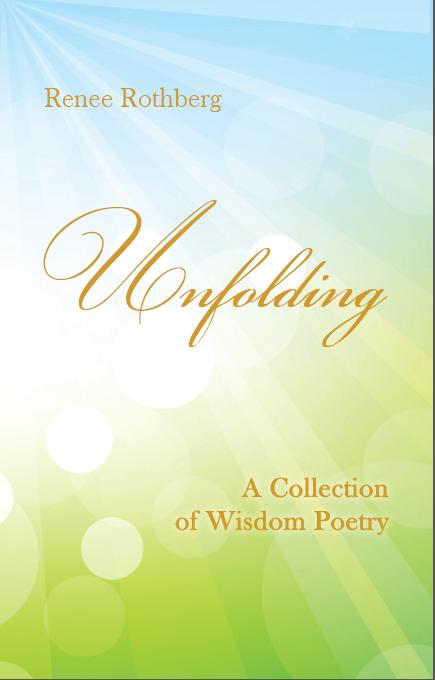
Unfolding book cover

I’m happy to announce that Unfolding—A Collection of Wisdom Poetry has been published on amazon.com: http://amzn.com/1508828229

What is wisdom poetry? Here is the definition from the Foreword:

“Poetry is removing the excess words and focusing on the essence.

The poems in this book are wisdom poems from Spiritual Presence. A wisdom poem is a poem that is dictated directly from Spiritual Presence. Each poem shares/provides/shouts a message. Each message can lead to connection and balance.

As you read the poems, consider the messages and partake of their energy and truthfulness.

So much wisdom in so few words!”

Unfolding-To the Reader

Post 107-entertainment

My life is lived with constant awareness of spiritual connection. Sensing all the time that my actions have consequence and pull on myself and others. When I participate in building activities—activities that build my character, body, or thoughts, or that build my community—I am living my spiritually designed life. When I participate in non-sustaining activities—activities that waste my precious time or cause hurt to myself or others—I live emptily. Full or empty, I get to choose and my choice demonstrates my connection to spiritual living.

Before I was as connected as I am to Spiritual Presence, I had a sense of the importance of my daily life choices. Now I am constantly aware of the importance. I choose more building activities than I used to, but nonetheless, the call of mindless pursuits continues to sidetrack me.

When I work with people in individual Energy Guidance Complete sessions, I soar in the spiritual connection, although it appears to the person sitting across from me that I am focused elsewhere but am Renee grounded. As I converse with Spiritual Presence, I am elsewhere—neither grounded nor flying, rather in a state of transposed being. I look like I’m here, but I’m actually mentally moving beyond.

This place of conversation with Spiritual Presence feels natural to me so I present it in a low-key, natural way to the people receiving the spiritual messages through me. The messages are truth revealed, and yet the receivers often don’t grasp the largeness of the words that come through me. I offer each person’s truth that can bring balance and well-being, and yet, some cannot take the words and apply the truth. As Renee, I feel saddened and frustrated when people don’t realize the amazingness of the messages. As the voice for Spiritual Presence, I feel waiting. Waiting to be heard and waiting to be connected. And so I continue to soar and bring the messages to each person who is ready to hear.

The conversations with Spiritual Presence can be moving and wise. The conversations can also be casual and minor. I myself don’t comprehend the largeness of the connection, because it now feels so natural. In my poetry book Unfolding, I delve into my connection with Spiritual Presence. Here is an excerpt from the poem:

Poem-Connection with Spiritual Presence

Life from within spiritual connection is amazing! enlightening!
clarifying! a responsibility! sometimes lonely!
filled with wisdom!
filled with connection!!

David statue-trees

The statue of David.
Standing in its grandeur,
So tall and arresting,
Its beauty is breathtaking.
To see it
Requires entrance fee
to the museum,
Plus a visit to Florence.

The tree across the street.
Standing in its grandeur,
So tall and arresting,
Its beauty is breathtaking.
To see it
Requires opening
one’s eyes
To the masterpiece at home.

This poem is from the recently published book of poetry named Unfolding.

Other poems in Unfolding:

http://amzn.com/1508828229

Post 80-Attention

For optimal health, the following health maintainers should be monitored:

  1. Consumption of nutritious and satisfying foods. (Focusing on foods that are bereft of nutritional value or are lacking in the aspects that naturally gratify [for example, fat-free foods] undermine physical, emotional, and intellectual health.)
  2. Interactions with other people. (Too little interaction undermines emotional and spiritual health.)
  3. Participation in physical activities that bring joy and challenge. (Participation in physical activities that are not enjoyed undermines emotional and spiritual health.) Daily physical activity is necessary to keep the bones, muscles, and flows working properly.
  4. Rhythmic breathing that is varied and appropriate for the body’s activities.
  5. Sensitivity to environmental concerns. (Disregard for plant life, water sources, and conditions for animal rearing undermines the grounding of the world and damages physical and intellectual health.)
  6. Appreciation for life’s gifts.
  7. Attention to self-needs. (Ignoring one’s needs damages all the aspects of balanced health. This area does not mean self-centeredness. It means self-support.)
  8. Sufficient and satisfying sleep.

Each of these health maintainers is vital for well-being and balance. Focusing on a few of them is not enough.

“A good life is one in which a person knows that he or she has affected, uplifted, and connected.” from the book “Vitality!”.

http://amzn.com/1499599196

Sea

The sea called to me one day,
so I went by.
The sea shimmered its magical view,
so I went in.
The sea rushed around me,
so I let it wash over.
The sea beckoned me to listen,
so I did.

I heard
the sound of the sea
and it said…

notice the music of everyday life
drown out the pull to feel entitled or hurt
fill up on memories and movement and connections
let the expectations move on
let the wonder come in.

The sea called to me one day,
so I went by
to hear its song.

From the upcoming book of poetry titled Connection.

Note from 05/08/15: I’m happy to announce that Connection—A Collection of Wisdom Poetry has been published on amazon.com: http://amzn.com/1511788259

Forty

The following list was presented in two earlier blog posts. I am presenting it again because it is really important. Please look at each contributor to poor health and consider it. Each one won’t apply to you, but it may apply to someone you love.

Notice that sleep deprivation is the second major contributor of poor health. This one is really not that hard to fix. Notice the third contributor. Letting the body heal itself when possible can lessen the grasp of this contributor. Notice number five. then get up and dance around or walk in place.

Each contributor can be lessened.

——–

In modern societies, there are 40 reasons that a person becomes deceased too early or suffers too much. Here are the reasons in the order in which they contribute (accidents and disasters are not included):

  1. Overconsumption of alcoholic beverages
  2.  Sleep deprivation
  3.  Misuse of legal drugs
  4.  Depression
  5.  Insufficient regular movement of the body
  6.  Overuse of cigarettes
  7.  Insufficient protection from the elements (cold, heat, etc.)
  8.  Chronic insufficient consumption of water
  9.  Overconsumption of food
  10.  Insufficient exposure to the environment (nature)
  11.  Worry, fear, and anguish
  12.  Suppression of negative emotions (worry, fear, and anguish)
  13.  Hurt feelings
  14.  Blood pressure pressures
  15.  Isolation
  16.  Genetics
  17.  Misjudgment of self-boundaries (When relating to other people, not understanding how to bond. When relating to tangible items, not understanding limits and excess.)
  18.  Insufficient intake of vitamin-rich foods
  19.  Memory loss
  20.  Insufficient intake of mineral-rich foods
  21.  Digestive disturbances
  22.  Elimination issues, such as constipation
  23.  Too much dependence on approval from others
  24.  Inadvertent consumption of foods that cause allergic reactions
  25.  Overexposure to toxins
  26.  Sense of unworthiness
  27.  Misuse of illegal drugs
  28.  Purposelessness
  29.  Sadness
  30.  Misjudgments in sexual relations
  31.  Lack of trust in one’s intuition
  32.  Chronic under-usage of the thinking capabilities
  33.  Overemphasis on physicality
  34.  Anger
  35.  Jealousy
  36.  Eating too little
  37.  Indifference
  38.  Overusing the body physically
  39.  Feelings of devaluing others
  40.  Choice inundation

 You may have noticed that shallow breathing and other breathing issues are not on the list. Improper breathing results from many of these issues so that breathing, or rather, incorrect breathing, is often part of the causes.

Underachievement

Underachievement

What does underachievement mean?

It means knowing what you want, but settling for something else.

It means having companionship that causes you shrinkage.

It means following the path of others when those paths are inappropriate.

It means seeing yourself in a belittling mirror.

It means agreeing to suggestions that just hearing them causes shutting down.

Who are affected by underachievement?

Children who aim to please no matter what the request.

Partners in a relationship who agree to unwanted treatment.

Friends who have their own opinions but are ignored.

Followers of celebrities who allow the celebrities’ achievements to be more important than personal achievements.

Why do people let themselves underachieve?

Boredom

Fear

Guilt

Culture

Ease

How can an underachiever bring change?

Find positivity in aspects of one’s life.

Grow these positive aspects.

Allow the positive aspects to be the focus.

Writing Life

Post 30 luck

From the upcoming book of poetry titled Connection.

Sitting at
a table
on a bed
in a park
by the sea
near busy shopping areas

Writers absorb life.

Observing with
curious eyes
wondering ears
flexible ideas
examined experiences
inspiration sources

Writers receive life.

Concentrated creation
involved development
bated breath
changing pace
sensing guidance
temporarily away

Writers feel the writing.

Personal hindrances
learned  routines
family needs
daily responsibilities
community influences
living requirements

Writers manage interference.

 Like others,
Writers struggle with
Daily obligations and
Self-inflicted stumbling blocks.

 Unlike others,
Writers wear the
Call to write
Inside their bones.

People to watch

(a re-view of the post “Sometimes the Least Boisterous Person is the True Star—The Dos & Dont’s of Notice”)

Attention

True attention deservers are the ones that take part, help out, and bring hope.
The others deserve less notice…

In a gathering, there usually are the people who stand out. They generate more buzz, they attract attention. There are the people who mill around the buzz-makers and there are the people who make the buzz in the background.

The background buzz-makers are the real ones to follow, but they often don’t make the fuss that generates the action. These people do acts of kindness, make others comfortable, fulfill the role of support provider, and consider the needs of society. These people understand that they are obligated: obligated to care for their families and their community and obligated to remember the needs of the environment and of the creatures that inhabit the Earth.

There are stand-out individuals who not only generate buzz in the limelight, but also fulfill their obligations in much-larger-than-self ways. They, and the less visible obligation-fulfillers, receive notice in the spiritual realm where one’s actions really matter.

This blog post provides the Dos and Dont’s of getting noticed for behavior deserving of notice.

DO:  Fill your time with sustaining activities

Here are a few examples of sustaining activities from Pond a Connected Existence:

“Spending time with loved ones! Playing with babies! Teaching children in the customs and traditions of one’s forebears! Singing! Dancing! Singing well! Singing flat! Artistic expression! Preparing healthful meals! Picnics!  Family gatherings! Gatherings of friends! Gatherings of people for life events—sad ones and happy ones!… Working with gusto! Working with integrity! Working in unison and working alone! Group activities that have a higher purpose! Group activities that bring enjoyment! Walking! Running! Jumping! Riding a bike! Riding a wave! Swimming! Moving for fun and moving for health! …”

DO: Take care of the environment

Taking care of the environment includes planting plants, trees, and flowers. It also includes not littering and not being wasteful with the Earth’s resources.

DO: Take part in activities that bring betterment to the community and to the less fortunate

No matter how busy you think you are, you are not too busy to help out with a volunteer organization in your area (unless you are attending to a terminally ill family member which is consuming all of your time).

DO: Smile, even when smiling feels forced

A smile lifts the spirits of those who see the smile and the one who wears the smile. As an experiment, sing a song while not smiling and then sing the song again while smiling. Smiling simply changes one’s mood and one’s influence on others.

DON’T: Smile at a person if you are thinking bad thoughts about them

A fake smile cannot necessarily be detected by others, but it is recorded in the spiritual realm. Pretending to be happy when someone makes you unhappy is the incorrect approach. If someone really affects you in a negative way, either try to limit exposure to this person or try to change the dynamic.

DON’T: Fill your time with non-sustaining activities

“Non-sustaining activities include small things like watching too much TV, playing too many computer games, eating junk food, complaining about inconveniences. Larger non-sustaining activities include things like participating in aggressive behavior towards other people, other creatures, or the environment; eating too much food; focusing on the lives of people who have no true relevance in one’s life (for instance, following the movements of a celebrity or keeping tabs on old love interests); pretending to like one’s job or partner or pastimes or this or that, when one is unhappy…” – “Pond a Connected Existence”.

DON’T: Say no when asked to help just because you want more free time

“Obligation to one’s community is much larger than many people think. Taking part in elections, taking part in cleaning up, taking part in communal rituals—these are the basic obligations on all. Beyond those acts, one should participate in bettering the community. ” – “Pond a Connected Existence”

Saying no when help is needed does not earn notice where it matters. If you are feeling too tired, rather than lessening your sustaining activities, examine your less sustaining activities and consider lessening them.

DON’T: Be wasteful

Appreciate what you have. Don’t be greedy with your desires. In general, people want more than they need so try to be reasonable in your usage of resources that are not easily replenishable.

Conclusion

The notice being discussed here is not notice by the people seeking excitement. It is notice in the spiritual realm that considers the actions of people and provides spiritual connection or not.

The more a person strives to bring balance to himself or herself and to the family, community, and neighboring environment, the more possibility of spiritual connection and guidance. Balance within and with all lead to life lived purposefully and with spiritual connection.

cooking meatThere is a way to eat meat and that is with appreciation. Appreciation for the ease at which the meat is obtained and appreciation for the ability to have meat when wanted.

The ease at which the meat is obtained: in restaurants, fast food chains, meat markets, supermarkets, convenience shops, and through the internet. Meat is easy to come by. The fuss of preparing the meat for consumption has also been made easy: ready-made meats of all kinds, whole roasted chickens, frozen meatballs and link sausages, refrigerated sliced meats and meat salads, hot and cold meat entrees—and all of these are at the supermarket.

The ability to have meat when wanted. Because meat is so easy to obtain, it can be eaten as much as desired. There are even diets that tout meat as the main part of each meal. Bacon for breakfast, chicken cutlet for lunch, steak for dinner, beef jerky for a snack. Lox for breakfast, tuna for lunch, salmon for dinner, sushi for a snack.

With so much meat available, it is easy to forget the path the meat dish took to get to the table or into the take-away bag. The ease of the access lessens the appreciation of the meat, and so people who eat meat must make a special effort to add appreciation into each meal in which meat is eaten.

Becoming aware of the meat processing industries is a greater step towards meat appreciation. Buying meat from companies that support animal care can add to the appreciation and awareness of the animals that were raised and slaughtered on behalf of the human diner.

The most important appreciation is towards each cow, pig, chicken, turkey, or fish that gave its life for the meal sitting in front of you.

||Eating Living Dishes||

Animals
eat animals.

The eaten animals
are raw except
when they are cooked.

 Cooked animals are eaten
by people.

Even when
cooked, the eaten animals
have living aspects.

Life
can never be cooked away.

When eating living dishes,
eat with humility.

from the upcoming book of poetry titled Connection.

How much meat to eat? Spiritual Presence informs me that the right amount for each person is based on each person’s need for food that is filled with chewingness. Meat is a food to be chewed, and the chewing gives rumination satisfaction. Also, people who taste food through their sense of smell have a need for meat that is usually more than they need to eat.

Expanding Roots

Post 14-environment

People were meant to root like plants, to stay attached to the area in which they were born and attached to the people living around them. People are adjustable, though, and when events happen to uproot them they can adapt to new environments and different ways of functioning.

How do these facts relate to the modern world of less attachment to one place and movement from place to place?

Rootedness is an internal, deep characteristic that can’t be ignored. Rootedness is a mechanism for developing physically and emotionally. Rootedness contributes to feelings of security and the ability to identify expressions, such as expressions of concern and disdain. When a person feels rooted, the displays of personal responsibility are more frequent.

How to increase development of rootedness

  • If you live in an area that is very different from where you lived as a child, aim to create a network of support that provides emotional support and intellectual stimulation.
  • If you live in an area that is similar to where you grew up, aim to create a network of support that challenges you to be involved and influential.
  • If you live in an area that you dislike, create a “What I like about this place” tour and aim to find positive aspects of your location.
  • If you move from place to place, aim to develop relationships at local businesses, religious institutions, and organizations that are similar to ones you were active in in the past or do work that appeals to you. At each place, strive to build friendships, even if they are temporary.
  • If you live where you grew up, take part in the running of the city/town/community. Allow new residents into your network of support.

Personal responsibility through rootedness

When a person feels a sense of responsibility towards a place, natural desire to take part in its care usually occurs. People who are connected to their community tend to involve themselves in communal betterment and social networks. These connections contribute to well-being and health. When a person feels rooted, personal actions take on larger significance and personal contributions to the community are felt. Involvement in outside-of-one’s-own interests brings satisfaction that contributes to balance—balance of the person and balance in the community. Feelings of attachment to a place, whether through birth or through choice, brings gifts that are not often realized.

Wherever we live, we do good for ourselves when we send out roots.

wild flowers

Blossoming, captivating flowers
Fill the air with vision
Of fragrant beauty
To be had.

Lovely, coolish Spring days
Fill the nights with hopes
Of love and companionship
To be held.

Constant, melodic bird song
Fill the lungs with desire
Of expansive breaths
To be taken.

Spring in all its blossoming,
Fragrant, and melodic.
Magic, filling the
Life with freshness.

From the upcoming book of poetry “Connection”.

Connections

The previous post contained two words after the Connections graphic: “Your choice”. Not a lot of words, but a lot of meaning.

We get to choose how connected we want to be–to others, to our community, to our friends, to nature, to animals, to spiritual existence, even to ourselves and our own needs.

Over and over, we are told how important these connections are for our health and well-being, yet we can choose to build the connections or live disconnectedly. We get to choose.

 The choice to connect is yours.

Choice

Connections

Your choice

Connections

By design, people are meant to connect. They are meant to connect with other people and with their own needs, with the seasons and with the environment, with the animals who roam the earth, and with spiritual energy. Yes, that means each of us. Each of us, you and I, are designed and programmed to connect. Connection is built-in. Part of the people blueprint.

Although the connections are very different, they intertwine and inform one another. People are meant to depend on one another. They are designed to work in groups: to build together, to create communities, to help one another in times of difficulty, to find common purpose, and to help those entering and exiting life. People are meant to learn from the world around and to contribute to its betterment.

The natural world has its rhythms and cycles, cycles of seasons and cycles of beginnings and endings. People are meant to fit into these rhythms and cycles, and to gain self-awareness through their observations. Observation of the animals adds to self-awareness and to appreciation of ourselves and of the amazement of life. Amazing too are the heights people can ascend when they allow their own self-abilities and personality to lead their lives. Opening to sharing in the wonder of the world with spiritual energy is opening to more vital and glorious living.

Each of us, you and I, are designed and programmed to connect and care and feel. Connecting to and feeling part of, caring for and feeling empathy, and feeling intertwined. The design is the design.

Song of Sound

Music has depth,
The depth of life aloud.

       Melody streams into the memory
Like a remembrance of life past.

Rhythm presses along,
Pushing towards somewhere else.

Sound calls all forward
With resonance of existence to be had.

The song of sound,
So deep within the being.

This poem is from the upcoming book of poetry named “Unfolding”.