A Balanced Approach to Wellness!

Airport kindness

Connections

I am on my way to the airport, sitting in a van that is collecting more people as we go. A good time to receive information.

I will write about the airport staff that work at the reception desks and how to deal with them.

The staff who will enable me to fly are bored. Day after day, they are sitting at a reception desk with the same people checking in—different heights, different passport numbers. The people checking in are excited or indifferent or worried or short-tempered. Same people—different expressions. Sitting at the reception desk and expected to be receptive to all who ask a question and to all who want a change. Same questions, different phrasing

How can I (we) connect to the staff sitting at the reception desk:

  1. Wait for the instructions before talking.
  2. Follow the instructions precisely.
  3. Complete this short person-to-person connection with a smile, with a thanks, and with a kind thought. The kindess will be absorbed and the boredom will be ever so slightly lifted.

————-

Each connection in our day-to-day, less regular, and once-every-so-often encounters is an opportunity for balance.

Renee by olive tree

“Reaching potential happens every day a person interacts with others and with the environment (with plants, animals, and other natural inhabitants of the world) in a constructive and uplifting manner. Each day brings an opportunity to move up or down, to build or waste, and to affect or be affected. Each day is another step on the journey.”  from the chapter “The Journey” in “The Gift of Intuitive, Dedicated Comfort”.

I am happy to report that “interacting with others” is being extended when I return to the US to bring Energy Guidance Complete to more people. Meeting with people and helping them achieve balance is rewarding and is a mission I have been given. Talking about Energy Guidance Complete and sharing the wisdom of soulful living is reaching my potential.

“Soul choices require conviction and strength! Soul choices require willingness to risk and willingness to falter! Soul choices require heart and blood! Soul choices require taking a stand and doing what needs to be done—when it needs to be done and without complaint! Soul choices are not always easy to make, but they are the choices worth making.”  from “Exploring Energy Guidance Complete, My Journey”.

Really listening to one’s inner voice is not taught, and so people have to learn their own way. Energy Guidance Complete sessions help build the path.

I start in Los Angeles, which will be my base. I worked there last March, and was soulfully lifted being there. In LA, I wrote the book about the soul. I am excited to see what topics will flow through my fingers this time.

Conviction and strength and willingness to give Energy Guidance Complete to others. These purposeful supports are guiding my work!

90 1- reality

“The feeling of life in one’s body is an extraordinary feeling. Noticing the feeling of being alive, of being awake, of being vital. Amazing! Yet we often take the amazingness for granted and don’t appreciate it. Too many of us focus on pain or discomfort or hurt feelings. Those things exist, but they are minor in comparison to the body’s vitality!

When the blues hit or the bones creak, they take the focus and move miraculous existence to second place. Keep in mind that emotional ebbs and physical challenges are just parts of living—but they are not the main elements. They steal attention from the important aspects of life, and we must be vigilant to not become immersed in the difficult and unhappy moments.” This reminder about the importance of perspective is from the “Introduction” in Vitality!.

10 : 90. This ratio is important to remember. It is the average of negative and positive things in a person’s life. 10% is the negative things; 90% is the positive things. The positive things are largely taken for granted and the negative things receive importance way beyond their significance.

10 : 90. Bah. That 10% feels heavy. How can it be so small? The little annoyances and the larger afflictions expand beyond their actual effects because they are deviations from the normal state and they are cacophonous communication from our bodies. When something is out of whack or when happenings occur that derail us, the noise they make catch our attention and require action. The 10% perpetuate. Because they bother or annoy or require attention, they grow—if not in actual size then in demand for attention. The 10% needs attention and resolution (when possible).

10 : 90. The 90% is the take-for-granted percentage. It includes these three things: sleeping and rising refreshed and ready for the next day (when sleep is not trivialized), regular functioning of the body, and ability to accomplish many goals. It includes these three things: having shelter from the elements, delight in possessions, and clothing for the body. And it includes home helpers (washing machine, refrigerator, lighting, entertainment suppliers [TV, stereo, computer, etc.], and many more), indoor plumbing, and food that is easily accessible and does not need to be foraged or hunted. Continuing on, there is photography and there is storage. The list grows and diversifies for each person, family, and community.

The 10 is small next to the 90  SMALL  Small   small. The 90 is deserving of thanks and attention.

Think 90 : 10 !


Too much meat

too much meat

Too much meat. In general, people eat too much meat. This message is not new. And yet, many people consider meat to be their required sustenance, their right. Their right to eat meat without boundaries. Meat, meat, and more meat.

This blog post is not about giving up meat. Meat is food that is nourishing and satisfying. This post is about remembering that meat is sacred food that comes from living animals and conscientiously limiting amounts that are eaten.

There are diets that place meat at the top of the diet plan. In other words, the meat is the most important part of the diet and is key to weight loss or weight gain prevention. Some diets espouse meat as the main food to eat in quantities that are not appropriate for the human body. These diets are harmful for the body and for the environment.

Meat is living-energy that requires respect. The life that was the meat existed yet it was cut short for human consumption. The animals that feed humans were living, were interacting, and were being part of the populace of Earth. The animals that feed humans are not people, but they deserve kind and respectful treatment. The animals that feed humans give their living-energy; this fact must be remembered.

People who eat more meat than their bodies need consume too much living-energy, and this over-consumption lessens the true value and significance of the animals. Eating less meat is responsible. The animals, like the people, are living, breathing creatures.

Cotton

“…when moments are wasted or spent on destructive pursuits or focused on valueless fluff, balance and security are taken away.”  This quote pounds us with the truth about wasting time in the chapter “Moment” in Pond a Connected Existence.

I know this wisdom; I truly do, and yet I still choose valueless fluff when meaningful endeavors call to me. Wasteful time wasters abound, and I let them pull me down. Down into the abyss of valueless activity. Far into the place where time is irretrievable, where time is lost and cannot be replaced. Time gone, flittered away on meaningless wispy fluff.

The lure of smallness is greater than the push to impact. Having an impact on others, on society, on global conservation, on local causes, and on family issues, is people-ness. Impacting and not ignoring, impacting and not allowing laziness to win out. To live with narrow expectations might seem easier, but in reality it leaves people empty when the end comes. When the end comes, knowing that impact took place because of one’s positive efforts makes the exit less difficult.

Energy Guidance Complete illuminates the way, but the way has to be followed. Step by step, one change at a time, one better choice and then another. Following the guidance because it is wise and then following the soulfully felt guidance because it is intuitively wise. Energy Guidance Complete and soulful guidance: two ascents that flow from the same source.

(This post is from Exploring Energy Guidance Complete, My Journey, the book I am currently writing.)

illness

Illness is end result of improper or incorrect care. Illness reflects prior actions and illnesses. Emotional responses and imbalance can also trigger illness.

The main contributors to ill health are discussed in an earlier post: https://energy-guidance-complete.com/2014/06/05/the-forty-contributors-to-ill-health-and-to-possible/ These contributors also contribute to the various illnesses that strike. For example, sleep deprivation and dehydration can lead to general ill health and to succumbing to a virus.

The body has defenses to protect against invading germs, but if these defenses are troubled by internal weaknesses or disruptions, then the germs can overcome the defenses. Balanced health is required to keep the germs at bay.

When the body is chronically weak and disrupted, illness can cause life-changing consequences, as happened to an acquaintance. He is now in a facility that handles people who are well enough to not be in a hospital, but are too far gone to be at home. He was an active and innovative community member who overlooked his own physical needs. He slept too little. He ate too little, and when he ate, he often ate foods that did not nourish. He forgot to drink water regularly and he forgot to wear warm clothing when it was cold. He was emotionally inundated with other people’s problems and he would forget to address his own emotional hurts. He was spiritually searching, but not spiritually open to personal spiritual connection. His health was overlooked, and illness was seen as a nuisance. He became ill a few years ago, ignored the illness, became ill a few more times, took various medications (but not better care of himself), and  his body eventually “turned” on him. His decline was all-encompassing affecting his physical, emotional, and intellectual health. Doctors were consulted; medications were administered (with some success, but with too many side effects); workload was lessened; people were avoided. His chronically ill-cared-for body could not overcome the onslaught of germs, worry, medications, more worry, and more germs.

This post is a reminder to take care of yourself and to treasure the body that houses your soul.

Packaging

packaging

Today I received a lovely holiday basket nestled in a large cardboard box and secured with a bountiful supply of bubble wrap. The basket was wrapped well with thick plastic wrap and the gift items were displayed individually on a wide basket that had plenty of shredded filler paper. Included in the gift items were individually wrapped and several-items-together treats. Also, a lovely ribbon encircled the thick plastic wrap that encircled the basket and gift items.

I recycled what could be recycled and threw away what could not be recycled. I have eaten—and enjoyed—some of the items, and will enjoy the others later this week.

Here is a message from Spiritual Presence about all the packaging (not just on my gift):

STOP! Too much waste. Too much selfish thinking. Stop creating things that require wasteful packaging. Stop using large boxes to encase small items. Stop wasting paper and plastic. Stop thinking that fancy is better than plain. Use simple wrapping materials. Be willing to like less rather than more. Be willing to demand simple. Take a stand. Honor the environment.

Tips to reduce packaging

  • Use reusable bags when shopping.
  • Use reusable bags when buying produce.
  • Use your own containers at stores that sell by bulk.
  • When packaging items, use as little packaging materials as possible. Remember that very few people appreciate the shredded filler paper and the fancy tissue paper.
  • Consider the environment each time you package something and when you order something that will be delivered in a package.
  • At restaurants, order less food so you don’t require packaging for food to be taken home.
  • Favor restaurants that use non-disposable plates, cups, cutlery, etc.

Community involvement

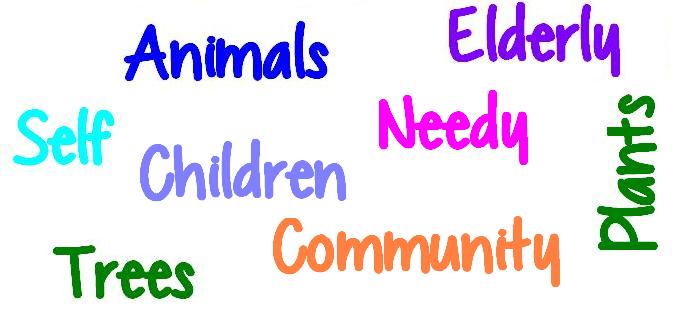
“… a community has various needs that are ever-changing and that differ in importance. The elderly need to be cared for, as do the teenagers. The animals require attention and so does the regional government. Trees and plants give shade and beauty, and they require upkeep and protection. The poor must be seen, and the recycling must be gathered. Each person in a community can participate in an endless number of community efforts, and the more each person does, the more the community radiates warmth and support.

Affect is the goal for each community member. Caring for self and caring for others. Acknowledging needs and addressing them. Connecting with people, relating to the environment, tending to animals. Developing oneself through the attention to community.”

-from Exploring Energy Guidance Complete, My Journey, the book I am currently writing

(taken from my article of the same name on Healing.Answers.com  )

OLYMPUS DIGITAL CAMERA

Delighting in simple pleasures has become a lost art. Very young children do it; they can’t help themselves. They haven’t yet been conditioned to expect more.

Being told to delight in simple pleasures is a rather broad commandment.  First of all, what is a simple pleasure? Second of all, what exactly does it mean to delight in something? And third, why is it so important?

What is a simple pleasure?

A simple pleasure is a thing, a connection, or an event that causes a person to feel a smile within the body. In general, large and elaborate things or events that, while positive, create different reactions within the body.

Simple pleasures rarely change in life. What delights a child should delight an adult, unless the adult has been too tarnished or damaged. There are infinite simple pleasures and each person feels perhaps 3,000 in his or her lifetime. The more open a person is to the amazement of life on Earth, the more simple pleasures he or she can feel.

Examples of simple pleasures are:

  • Seeing a beautiful flower, smelling it, touching its petals
  • Approaching a large tree, looking up into its leaves so high above, touching the bark
  • Walking barefoot on sand and feeling it between the toes
  • Standing outside during a mild rain shower with face uplifted to the sky, feeling the drops on the face
  • Being held by someone who loves you
  • Being rocked by someone who loves you
  • Holding a pet in your arms, stroking the fur, seeing the pet’s reactions
  • Feeling strength in your hands, their versatility, their capability

What does it mean to delight in something?

To delight in something means to roll in its hold on you. Not to really roll, rather to let it take you over in childlike amazement. As if you are a small child witnessing wonder.

Many people lose the wonder of things as they age and experience experiences over and over again. To see a tree for the millionth time is less amazing than seeing a tree for the first time, and yet, the millionth tree is really as amazing as that first one. Finding delight in each and every experience that is pleasurable is a goal worth pursuing. Avoiding becoming jaded, avoiding becoming apathetic.

Why is it important to delight in delight?

The more we let ourselves be moved by the joyous moments in life, the more balanced we are. Our bodies and souls require HAPPY for proper functioning. Even when life is difficult and challenging, finding delight in simple pleasures can affect the way in which we handle the challenges and low tides. Finding moments of un-joylessness, un-annoyance, and un-restlessness lead to balance and to meaningful existence.

Tip

A simple way to recall the joyousness of childhood is to be outside near a plant that has a scent you find pleasing.  Sit down next to the plant and let yourself be absorbed by its scent and its fullness of life. (Be sure to protect your clothes before you sit; otherwise, you’ll be upset when you see your dirty clothes and forget the joyous moment!)

Conclusion

“The importance of delight” is the title of this post. It is also a directive from Spiritual Presence about our lives. Life is not meant to be easy, but it is meant to be interesting. The more we find pleasure in the world, the more we can contribute and receive.

trusting eyes

Look into the eyes of a person whose faith is sure. You will see longing and hope, resolve and centeredness. Certainty in, security in, and clothed in are the descriptions of a person of faith.

Faith is intangible. Faith is an acknowledgement. Acknowledgement of belief and acknowledgement of acceptance. Acceptance and belief enable the surrender to beyond-self possibility.

The intangibility of faith is the difficulty for doubting minds. Proof of beyond-self is wanted by them, but intangibility is just that—intangible. To experience the sense of beyond through gut feelings, flashes of knowing, inspiration (to name a few) is the proof for acceptance of beyond-self.

Faith is opening. Faith is reassuring. Faith is balancing.

Open to the possibility of beyond-self reality.

blog

A person experiencing life in a no-need-to-strive way is living life partially.

Striving is a built-in endeavor for staying alive. In past times when survival was the driving force, the importance of striving to stay alive was utmost. In modern times, survival is assumed and so, striving to stay alive is less governing. Nonetheless, the natural urge to strive remains, and it requires direction.

Many outlets are available for the urge to strive. There are goals to achieve and goals to overplan. There are goals to continuously maintain and goals to share. There are goals to do in unison and goals to do alone. Building family units and community tasks are continuous striving outlets. So too are one’s personal care and ideas.

The conveniences of today enable striving that is optional. Optional striving confuses. Optional striving stresses. Optional striving can lead to immobility. It can even lead to conceit and laziness. Striving that is optional is a luxury that can be negative or positive depending upon each person’s actions and decisions.

The way in which a person chooses to strive–or not–is reflected on his or her face. Too many people have opted to ignore the drive to achieve, and their bodies reflect this mistaken choice. Striving for personal balance (physical, emotional, intellectual, and spiritual) and for community connection are purposes that nourish the built-in force to strive.

“Purpose in life is the force that enables overcoming obstacles and other difficulties. Finding purpose is a must for experiencing satisfaction in one’s comings and goings. …”

from https://energy-guidance-complete.com/2013/11/04/striving-and-striving-more/

Ferocity

These days the headlines scream terror. Many people doing many bad things to victims of bad timing, being there by happenstance, disliked group affiliation, or suspicious lifestyles. Ferocity is an innate quality in people—in all people, but it is usually contained. When ferocity is allowed to take hold, the results are often tragic.

Unkindness is not an innate quality; it is learned. Children learn it from caregivers and people who affect their lives when they are young. Unkindness is doused on others, and it drenches but does not pass into the behavior, unless the unkindness is consistently administered or is traumatically experienced. Unkindness that has become part of a person opens the person to release ferocity.

Uncontrollable hatred is also not an innate quality, but it is felt when it has been experienced or when it is lived by example. In other words, children who experience uncontrollable hatred directed at them may internalize it and use it against themselves or others, or children who see and hear demonstrations of uncontrollable hatred towards other people may unconsciously digest the hatred towards others and display it in the future. When uncontrollable hatred is felt and unkindness has been learned, ferocity develops.

Throughout history, people have viciously hurt other people. The cycle of ferocity does not change because people continue to teach unkindness and hatred. Ferocity can be controlled, but it requires conviction, understanding, declaration (public statements), patience, vigilance, kindness, and action by participants and sideliners so that the ferocity remains inactive. Conviction is the solution to ferocity—conviction that ferocity can be controlled and neutralized.

Tragedy does not have to be the norm.

This article is reprinted from Healing.Answers.com in the Personal Growth category: http://healing.answers.com/personal-growth/connecting-to-guidance

Post 92-spiritual connection

Have you ever felt a helping hand when you needed assistance? Have you ever sensed guidance during times of uncertainty? There are beyond-life companions that bind to us, and we can access their help and their hope if we are open.

How to Become Aware of Guidance

Awareness of guidance is different for each person. Someone will feel a “kick in the pants”.  Someone else will feel a “tug at the heart”. Guidance can feel like vibrations throughout the body or gentle touches on the skin or flashes of inspiration. Feeling a sense of security or a gut feeling or opening in the throat or a knock on the head are sensations of guidance. Hearing a soundless voice or tasting a sense of a known substance are other forms of felt guidance. Many other types of awareness occur, and each person can experience one of more of these forms of communication.

How to Learn from Guides

Guidance from beyond is available to all, but because of movement away from nature and away from openness to beyond-human-interactions, many people cannot access guidance.  Guidance from beyond transfers wisdom from those who came before. The wisdom assists with decision-making and action-taking.

Each person learns differently, but there are general guidelines. Awareness of how guidance is transferred is the first step, and each person must ascertain the communication forms for himself/herself. The next step is to determine if you want this help. After that, decide how and when you want to use this communication.

How to Develop Patterns that Increase the Guidance

In general, the more a person is connected to nature, the more easily the connection to beyond happens. By observing nature through the senses, connection to beyond usually increases. Although the connection to nature is not necessary for communication with guides, the connection does assist in developing awareness of guidance.  Increased guidance happens when connection to possibilities is cultivated.

What does it mean to cultivate connection to possibilities? Being attentive to the guidance indicators (kick in the pants, tug at the heart, etc.) cultivates connection to possibilities. Being open to receiving the communications and then using the assistance when it is received builds connection to possibilities. Being accepting of oneself is also a way to increase the guidance.

There are no definitive steps for communicating with beyond-life companions, because each person has a pull towards/push away from such communications that is influential in creating or denying the ability to connect. Openness is the key to possibilities.

Post 78-Sadness

Sometimes terrible things happen to people. Sometimes young people have serious illnesses that disfigure or damage them. Or weaken them so they die too young. Sometimes natural disasters befall people and they are left homeless, hurt, or confused.  Or orphaned. Sometimes people hurt other people—intentionally or not—so that trauma or death results. Sometimes people damage themselves—intentionally or not.

In all these cases, the survivors and caregivers are required to continue on and live. Not an easy task. Caregivers suffer daily, both physically and emotionally. Survivors suffer too, although differently and in varying degrees of despair, guilt, and shock. Both are in need of support, kindness, and openness to their pain. In other words, a survivor or caregiver needs a quiet  audience (meaning the listeners are quiet) for them to bare their sadness. If the audience is not quiet, the sadness might not dissipate. Quiet and constancy are the qualities of people who are helpful to those who need to give way to the effects of their sadness.

When sadness hits because of the natural order of life (a parent dies in old age), the survivors also require the same quiet and constancy. Sadness is sadness no matter the cause, although extra understanding should be given to the survivors of tragedies.

The person who has suffered the trauma (but not death) needs even more constancy and support. This person must eventually release the hold of the trauma. As described in the book Oneself-Living :

“Negative remembrances require determination and desire to purge them. Negative remembrances that are traumatic are often too difficult to release with-out continuous and relegate-to-a-less-prominent-place focus. Although traumatic events damage the connection to self and the sense of security, a person can remove the vicious side of a trauma so that a normal life can be led. Leading a normal life means focusing on the tasks that are done each day to sustain life: intake of food and water, sleep, interaction with others, and appreciation of the natural environment. Holding on to the tainted memory(ies), or holding back because of self-manufactured fear, prevents purging of the trauma of the event. The trauma must be released.”

Sometimes, terrible things happen to people. Terrible things also happen to the animals that inhabit the Earth. Terrible things happen. Can something be done? Towards the animals, much can be done. Towards people, less can be done. Towards animals, much painful treatment are day-to-day practices that people do to animals for food, clothing, and decorative items. Becoming aware of what is done to animals is the right thing to do. In general, people have less control over the tragedies that happen to people. Nonetheless, awareness of wrongful treatment of people should bring action from people who can affect change.

Sadness is sadness, no matter the cause. Releasing sadness can be done—with patience, with kindness, and with readiness.


Expiration date

Recently, a person died who I didn’t personally know, but many people I know knew him. He was only 48-years-old and he died of a heart attack. This event has prompted me to revisit the post “The forty contributors to ill health and to possible…” https://energy-guidance-complete.com/2014/06/05/the-forty-contributors-to-ill-health-and-to-possible/

Sleep deprivation is number 2 on the list. Number 2! Sleeping too little is fatal! Sleeping too little clouds judgment, exaggerates emotional reactions, and causes accidents. Sleeping too little deprives the body of the time it needs to rejuvenate and repair. Sleeping too little, when combined with other factors, negates healthy aspects of living (proper diet and exercise). Sleep deprivation needn’t be, because each person can know his or her sleep needs by paying attention to the body.

Insufficient regular movement of the body is number 5 on the list. Number 5! A bit of exercise here and there is not enough. Our bodies were designed to move—often.

Chronic insufficient consumption of water is number 8 on the list. Lack of regular hydration taxes the body and increases illness possibility.

Suppression of negative emotions (worry, fear, and anguish) is number 12 on the list. Having any of these negative emotions is number 11 on the list, but suppressing these emotions is almost as bad. Feeling negative emotions is normal, but when they are constant companions they tax the body and increase illness possibility.

Feelings of devaluing others: number 39 on the list. Thirty-nine might not seem high, but when combined with other factors, can lead to an expiration date that is too soon. Negative feelings about others boomerang and cause lowered resistance to illness and disease.

Too soon is preventable, but it is more than eating certain foods and not eating “bad” foods. To understand the way to live a long and healthy life, look at the list of 40 and live oppositely to all 40. It is never too soon to change direction!

Waiting

(This post is for Debbie, who is waiting with her beloved mother.)

Life causes us to wait—impatiently sometimes, agonizingly sometimes.

When a loved one is struggling to overcome illness or pain, the waiting is impatient for the sufferer and for the loving observer.

When a loved one is moving towards death, the waiting loosens. The sufferer who is prepared to leave life releases expectations and waits expectantly. The person who loves the sufferer waits with unrealistic expectations for not-finality, with hope for not-finality, even with desire for continuous suffering, just not finality.  Sometimes this person is able to understand that the sufferer is ready to move on, and so the waiting lengthens into fluctuating time: fluctuating between time that passes agonizingly so and time that passes hurriedly bringing death on.

Throughout life there are moments of anticipation and of dread, moments of stillness and of movement, and moments of acting and of waiting.

Waiting is eased when it is shared with others who care.

Closeting

Closet

Secrets. Thoughts. Emotions. Worries.
Hiding away in the crevices of our minds. Jumping out of their hiding places when we purposely retrieve them or accidently let them surface. Reminding us of desires or events or suspicions or fears that we prefer to hide or forget or ignore or overcome.

Thoughts.
Thoughts distinguish each person. We all think about matters that enter our lives, and our thinking is individualized, like a fingerprint. Each person with fascinating thoughts about life, living, and edge-existence (edge-existence is awareness of oneself as a part of larger-than-self [nature] and of oneself connected to beyond-self [the spiritual realm]). Thoughts that seem too unusual are kept closeted unless the person has a secure sense of rightness.

Secrets.
Hidden away are the actions and thoughts that cause embarrassment, excitement, and anguish. They influence behavior even though they are meant to be buried. Each person has secrets that simmer. The simmering lessens or boils over depending upon availability of nonjudgmental support, the urgency to unload sequestered information, and the closeness of death.

Emotions.
All people experience life emotionally. Emotions are extensions of awareness. Awareness of one’s environment and one’s physical state elicit emotional responses. People whose emotions are nonexistent or are uncontrollable have suffered a trauma—through genetics or through injury. People whose emotions are denied by themselves often suffer from chronic illnesses that cannot be explained. Emotions reflect dynamism, and hiding them impact intellectual and physical health.

Worries.
Accidents can happen and misfortune can befall, but constant worrying about these things causes stunted development. Pretending not to worry, while secretly worrying, causes stunted development and inability to reach potential. Worrying is a result of fearful upbringing. Closeted worries require determination to release them.

The opening for repressed baggage is acknowledgement.

Green beans

This post is not about the vitamins and minerals in unprocessed foods. It is about the health benefits that occur when unprocessed foods are prepared. The more a person is involved in creating the meal he or she eats, the more uplifting and balancing the experience of eating.

We’ll use the snapping of green beans as our example. Green beans can be purchased in cans and in bags, ready for cooking, or even already cooked. The prepared green beans do provide nutritional value, but the benefits of preparing them from scratch are lost.

Here’s what happens when a person sorts and snaps fresh green beans:

  1. Muscles in the hands and arms are exercised.
  2. Muscles of the hands and eyes are coordinated (as in an exercise for fine motor skills).
  3. Muscles in the neck are lengthened.
  4. Muscles in the abdomen are tightened, especially if the work is performed while standing.
  5. Muscles supporting the spine are exercised.
  6. Muscles in the shoulder blade area and chest are coordinated.
  7. Muscles that are used during breathing are relaxed because the action of snapping beans causes a slowing of the breathing (if the person is not rushed).
  8. Muscles of the oblique groups of abdominal muscles and the reabsorption of water in the kidneys synchronize to optimize urine production.
  9. Muscles of the upper and lower torso move in syncopation, which strengthens and stretches them.
  10. Muscles in the face rejuvenate when movements are focused on the work. (Talking on a phone while preparing the food cancels this benefit. Singing while preparing the food does not cancel this benefit.).
  11. Many other muscles and body parts are strengthened and stretched as well.

The list above presents physical benefits from sorting and snapping fresh green beans. Here are benefits to the other components of health:

  1. Emotional balancing occurs when the work is done with a generous intention.
  2. Spiritual balancing occurs through connection with whole foods.
  3. If the work is done with family members, opportunities can arise for heartfelt conversations.
  4. The food is personalized; in other words, its role as nutrition provider is elevated.
  5. The color, texture, and shapes of the green beans at the various stages of preparation affect the senses in favorable ways.

The more a person is involved in creating the meal he or she eats, the more uplifting and balancing the experience of eating.

The benefits of preparing food from scratch cannot be overstated. Having a personal relationship with the food you eat is worth the time and effort.

(This post is dedicated to my friends and family who hadn’t realized the benefits that come from taking the time to prepare meals from scratch. ♥)

Note: This blog post has been spiritually received.

Curiosity-stilts

People who are curious succeed in business and in social situations more than people who hold back their curiosity. All of us start out as curious infants, exploring our world as busily as we can. Curiosity is built-in and propels development of our senses and our abilities.

Often, curiosity is halted because of societal restraints, family restraints, and environmental barriers. People who experience too much repression of their natural curiosity add to the repression by quashing their urges to learn and explore. Sometimes, the desire to experience is so strong that curiosity leads the way and the repression can be overcome.

People who grow up in a nourishing environment that allows natural curiosity to flourish are able to develop more freely. This type of environment does not guarantee achievement, but it does offer support.

To enhance curiosity

  • Approach the known with questioning. Do you always do something a certain way? Why is that? Notice your habits and question the ones that don’t make sense.
  • Approach the known with innovation. Notice the choices you make repeatedly. Do you eat the same foods over and over again without evaluating their appeal? Do you tire at the same time every day? Why is that? What can be done about these things?
  • Approach the known with wonder. When the rain starts, don’t rush to take cover. Feel the drops and be connected to them. Look at the trees and other vegetation that you see every day and really notice them.
  • Approach the known with certainty. The things that are familiar are comforting. Let them bring comfort, but then move beyond them. Explore something less familiar while keeping the familiar within reach.

Curiosity is with us from the moment we can experience awareness until the moment that we cannot. The more we let ourselves develop, the more fully we live!

flower arrangements-focused 2jpg

The view from inside is often critical and too focused. Self-examination usually reveals missteps and mistakes, faulty executions, and missing sound evaluations.

In reality, missteps and mistakes might have happened, but at a lower level than the internal review presented. People tend to be too self-critical and judgmental.

What is the new view?

The new view is examination without negative judgment, evaluation without name-calling and put-downs. The new view is passionate but realistic, thorough but forgiving, expectant but fair, demanding but evenhanded.

We know our capabilities and our aptitude. We know our achievements and successes from the past. Focusing on the desired goals and working towards them guide us and lessen the hold of criticism and self-doubt.

To repeat: focusing on the goals and working towards them, letting the criticism and self-doubt flitter away, is the start to a new view of oneself.

“Implementing openness and patience and understanding towards oneself provide the way for balancing personal opinion. Being open to one’s own abilities and gifts. Being patient when learning new skills. Being patient when trying new endeavors. Understanding that perfection is the realm of Spirit only and that the created perfection of the world flows from very imperfect segments. Perfection and perfectionism should be banned words! Unattainable, time wasters, alienating.” …from Oneself—Living